Same Audience, Same Budget: How One Identity-Rich Supply Path Lifted HCP Reach by 32%
We tested the same HCP audience across two paths and found a 32 percent difference in reach at a similar cost. The results suggest that the activation method, not just targeting, determines how much of a physician audience is actually reachable in practice.
Joshua Alvernia
CEO, WRANGO
August 19, 2026
Sign up and get the latest insights sent directly to your inbox
Most HCP media plans assume that activating an audience directly in a DSP that accesses multiple SSPs will provide optimal reach. That assumption is not consistently true in practice.
Wrango’s programmatic workflow, built on OpenX’s SSP infrastructure, resolves HCP audiences across more identity signals than a standard DSP upload allows. That gap matters at scale: industry analysis from a leading bid intelligence platform recently found that 55 to 75 percent of programmatic spend is exposed to cross-SSP duplication, which can inflate CPMs without adding proportional reach. To quantify the opportunity, we ran a controlled comparison across multiple specialty pharma brand campaigns. Within each campaign, the same deterministic HCP audience was activated through both paths, with creative, budget, flight dates, and bid strategy held constant. The only variable that changed between paths was the activation method.
Same audience. Two activation paths.
DSP-direct activation
The deterministic HCP audience uploaded as hashed emails into a leading DSP and activated across the DSP’s full SSP graph.
SSP Deal ID activation:
The same audience is activated through OpenX’s SSP Deal ID (OpenXSelect™), executed inside the same leading DSP, using multiple identity signals to match physicians across supply.
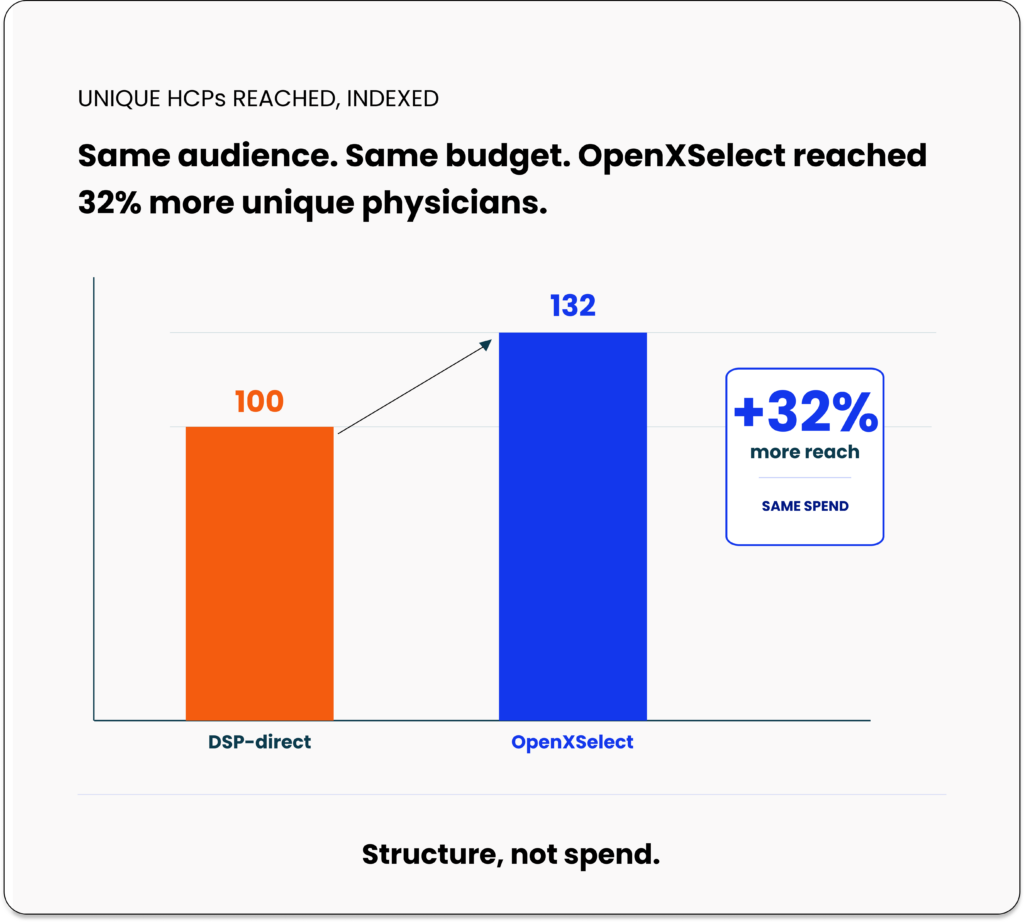
Activation method changed reach by 32 percent
Across the full study, OpenXSelect reached 32% more unique HCPs than DSP-direct activation, on the same audiences and the same budgets.
Creative, budget, flight dates, bid strategy, and the underlying audience were identical across both paths. The activation method was the only variable that changed, which makes it the only variable that can account for the 32 percent gap.
The difference is reachability, not targeting
Most audience activation today relies on a single identifier per segment uploaded. Targeting stayed identical across both paths in this study. Reachability did not.
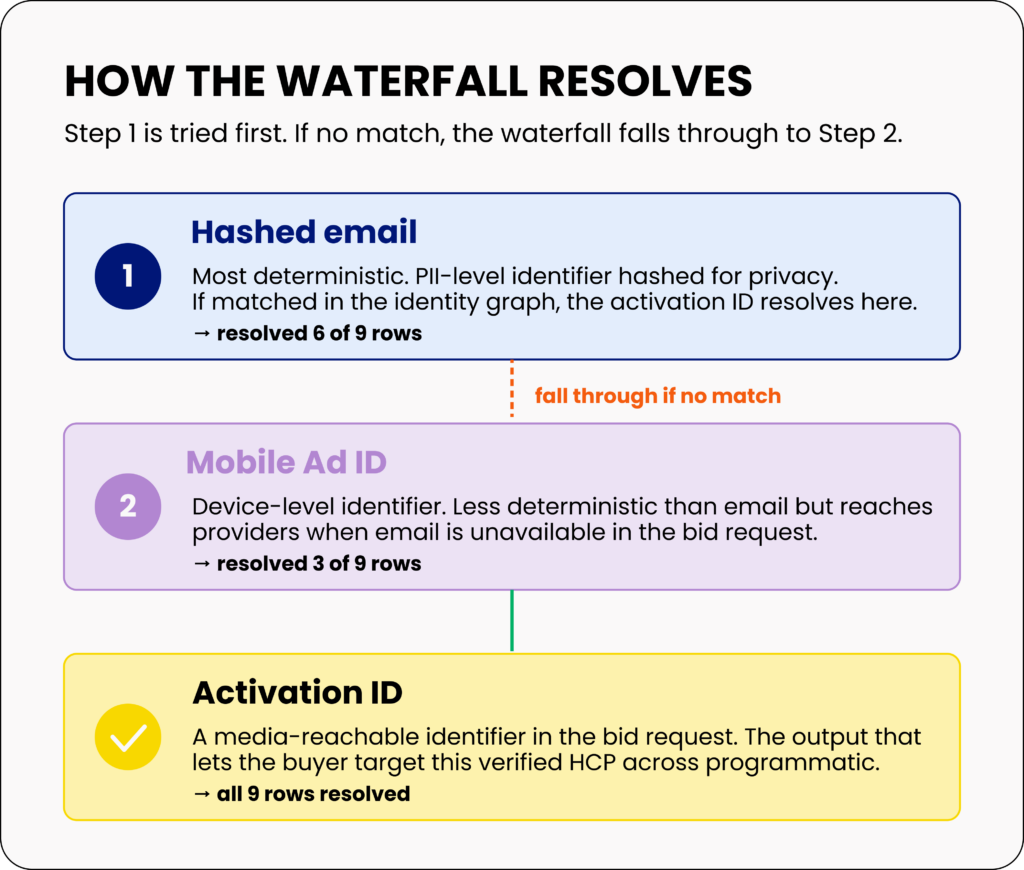
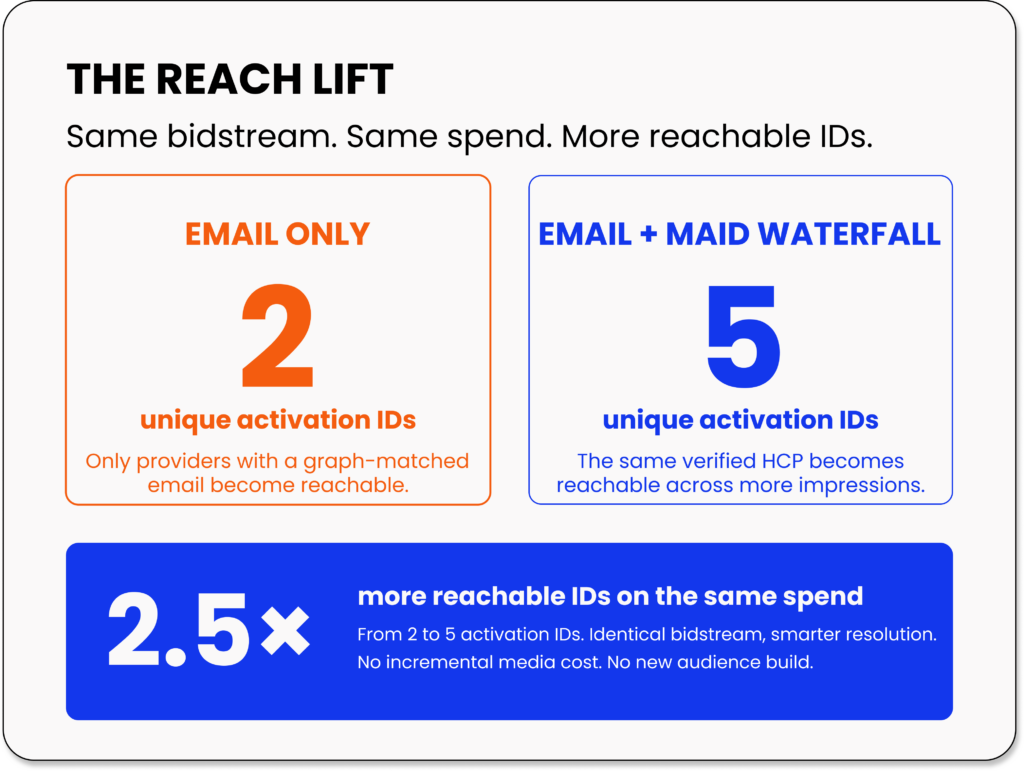
When activation relies on a single identifier, reach is limited to impressions where that exact identifier appears in the bid request. Wrango applies a prescriptive identity waterfall: start with hashed email, fall back to mobile ad ID, resolve through to publisher IDs. The same physician becomes reachable across more of their real digital activity.
The logic in three steps:
The payoff on a single HCP:
What this means for HCP media planning
HCP audiences are small and deterministic by nature. A specialty physician list doesn’t have the volume to absorb activation losses the way a mass consumer audience can, which makes identity resolution the lever that decides how much of that audience actually shows up, not just how precisely it was built. Our study shows you can leave 32 percent of the audience on the table before a single impression runs.
Start here: check whether your HCP audience is activated via a single identifier or through multi-signal identity resolution. A single identifier gets you part of the reachable audience. Multi-signal resolution, run through one identity-rich supply path, gets you the rest.
See it against your own media plan
This is the approach Wrango built with OpenX: one identity-rich supply path, resolved through a waterfall rather than a single identifier, so the same audience and the same budget reach more of the physicians you’re already paying to target.
Get access to the platform and we’ll walk through what this looks like against your brand’s HCP media plan.
Ready to Go?
Connect with our team for tailored HCP insights and a strategic media plan built just for you.
The Wrango Pixel resolves your HCP site visitors to verified NPIs. That one signal tells you who your campaign actually reached, primes your sales and next-best-action engines, and connects every touchpoint into one view of the provider.
Joshua Alvernia
CEO, WRANGO
June 24, 2026
Sign up and get the latest insights sent directly to your inbox
What the Wrango Pixel is
The Wrango Pixel is one tag you place on your HCP domain. When a provider visits, the pixel resolves that visit to a verified NPI against Wrango’s identity graph of 4.6 million providers. No patient data. No guesswork. You learn which providers came to your site, what they read, and how often they return.
Setup takes under 10 minutes. No sales call. No contract to start. No spend minimum.
Most HCP measurement still runs on proxies. Clicks stand in for interest. Pageviews stand in for engagement. The pixel replaces the proxy with identity. Once you can name the provider behind a visit, three things change.
1.You can measure audience quality and uncover your real cost per HCP
Every audience provider says it has high-quality HCP data. Verifying it is the hard part. Once a campaign is live on Google, Meta, Reddit, LinkedIn, or Pinterest, you cannot easily tell whether your ads reached real prescribers or just people who searched the right words. Keywords capture interest, not identity.
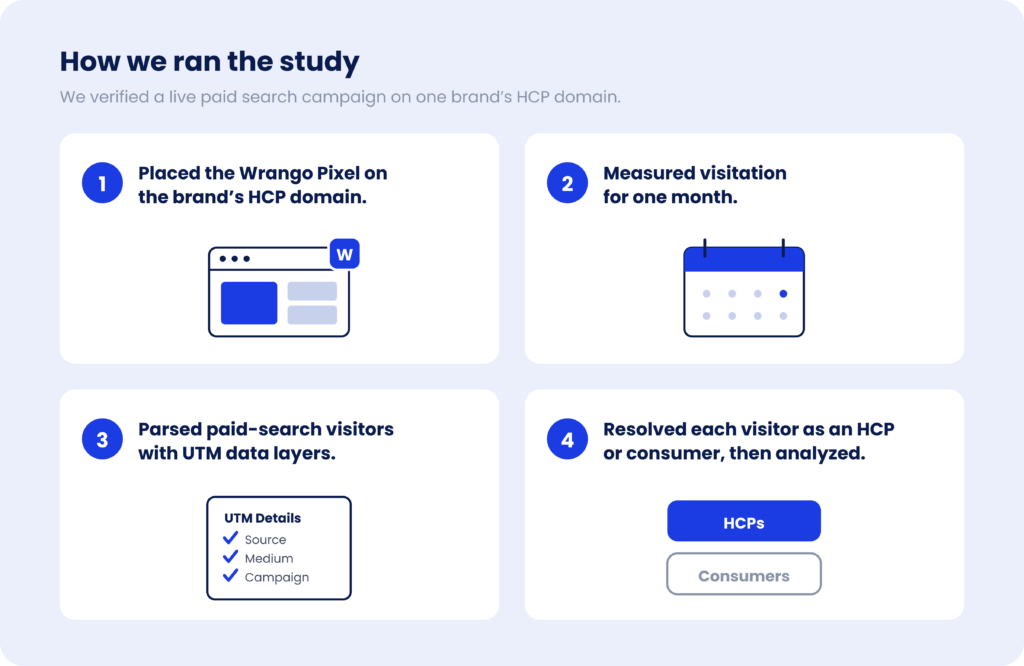
The pixel verifies it. To show how, we ran a study on a live paid search campaign.
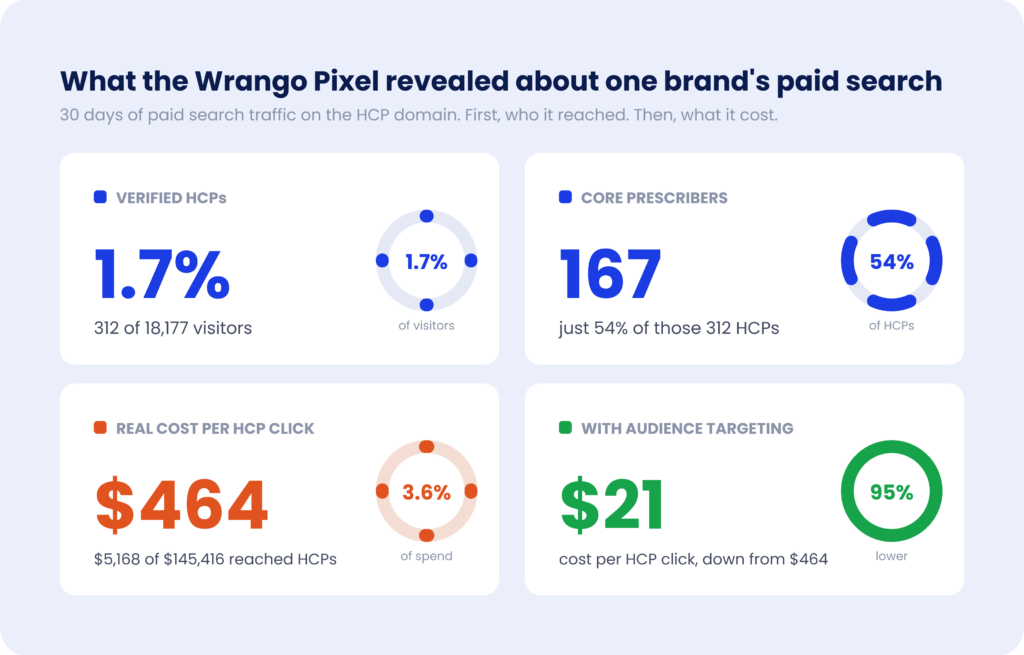
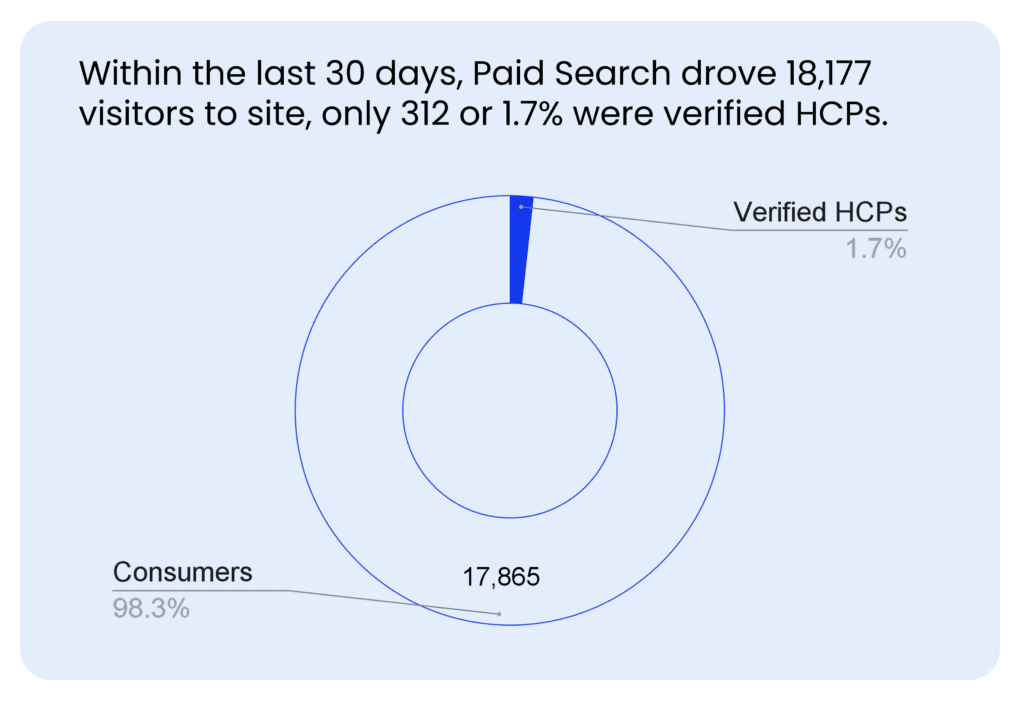
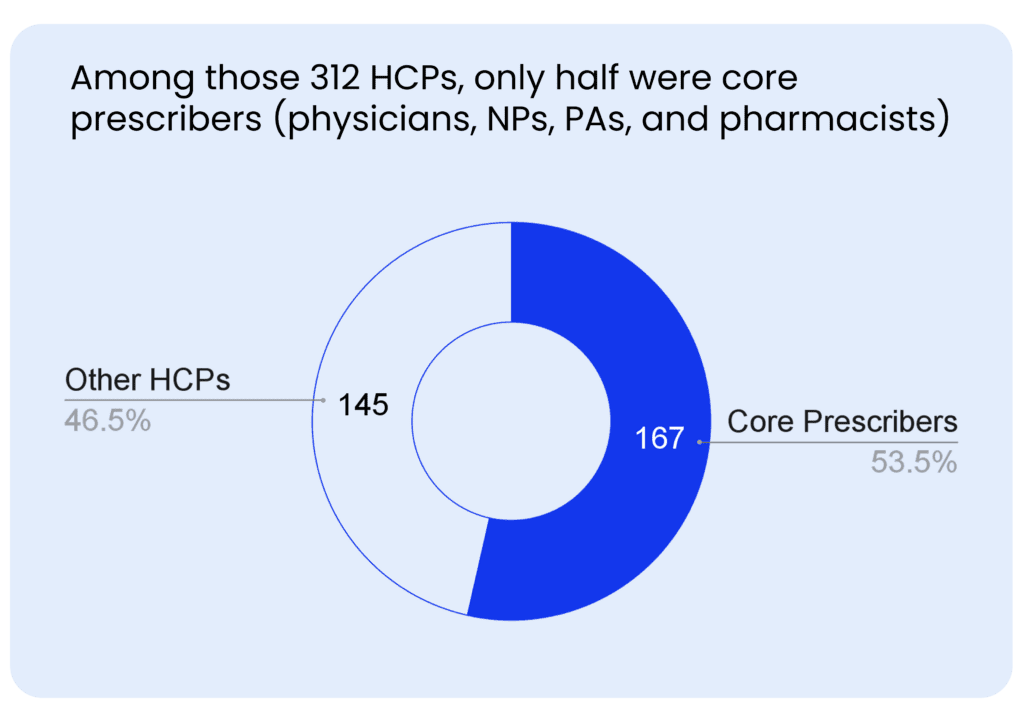
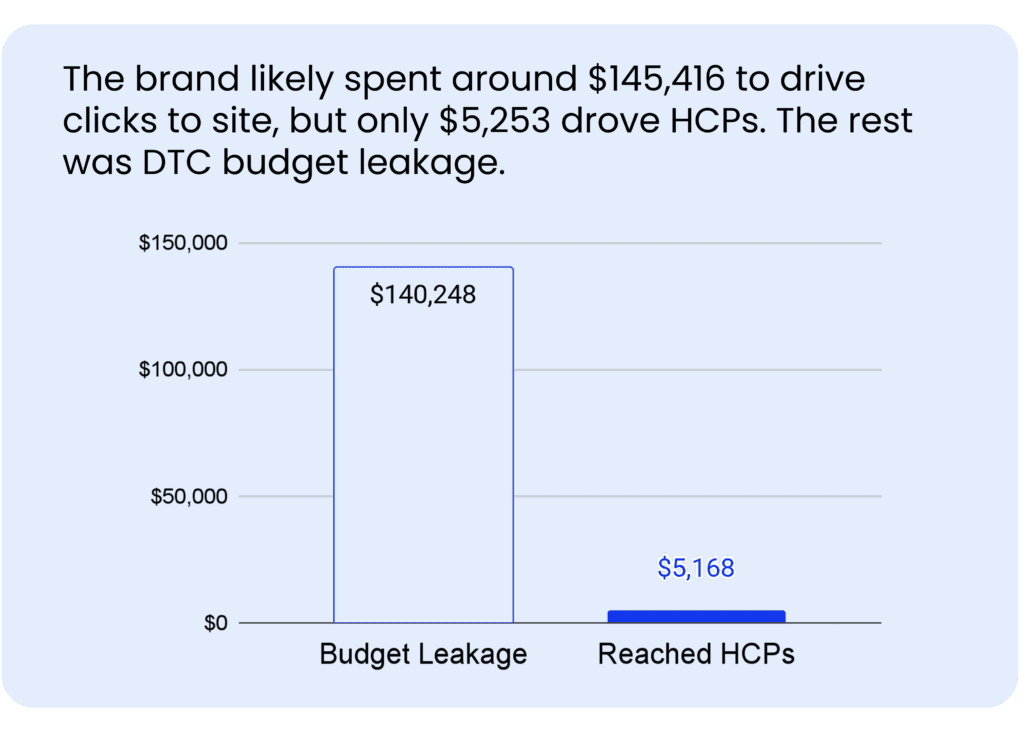
Here is what it uncovered. Of 18,177 paid search visitors in 30 days, only 312 (1.7 percent) were verified HCPs, and just 167 of those were core prescribers. The brand spent $145,416 on those clicks, but only $5,168 reached HCPs, which put the real cost per HCP click at $464. After we added audience targeting built from verified provider data, that cost fell to about $21.
The pixel is what made any of this visible. You cannot fix spend leakage you cannot see. NPI-level resolution turns “we got traffic” into “we reached 167 prescribers, and here is what each one cost.”
2. You can feed your next-best-action engine a verified list of engaged prescribers
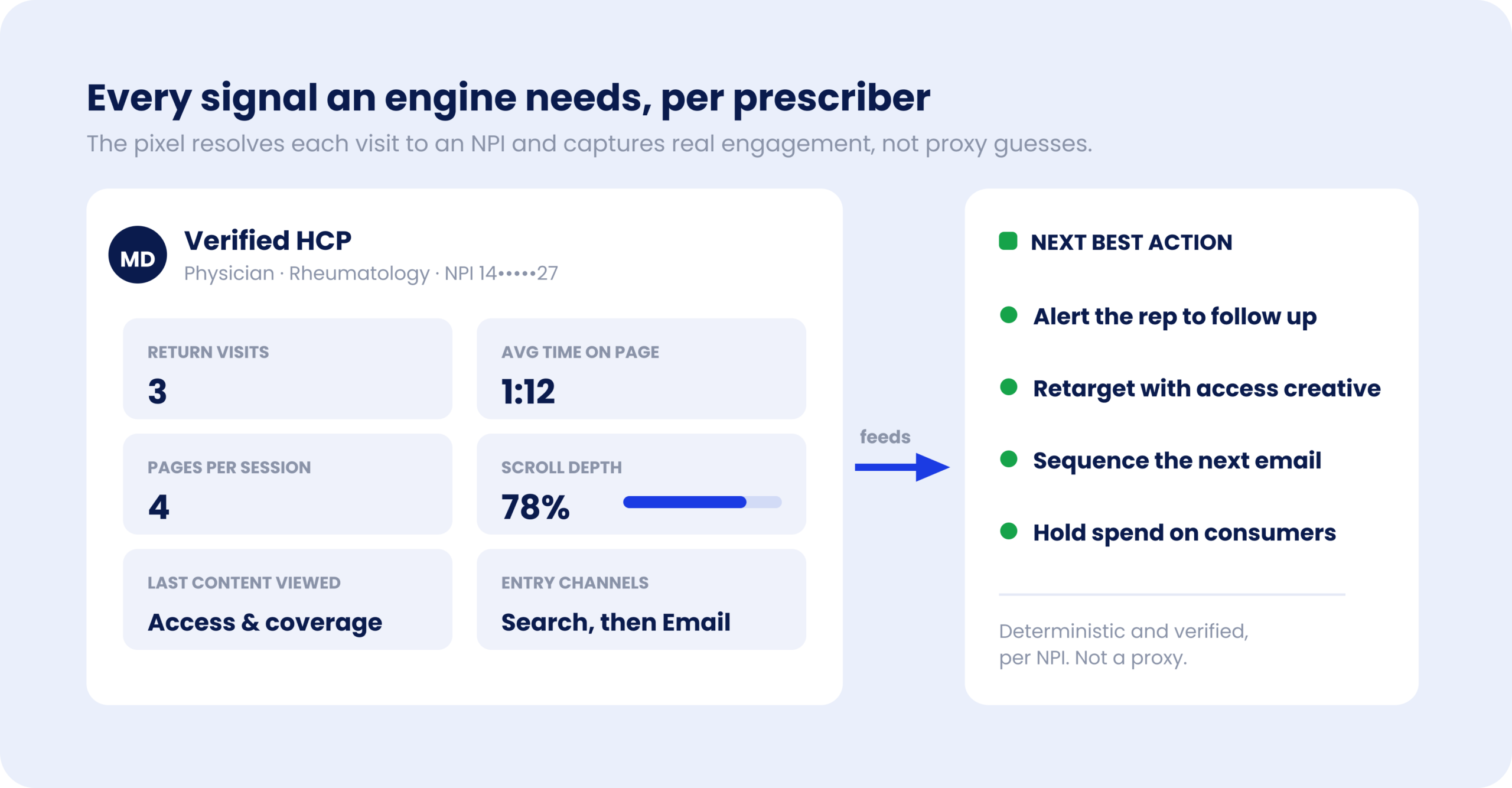
A resolved visit is a strong intent signal. The provider came to your site. They read specific content. They came back. That is very different from an email they never opened.
Wrango logs which NPIs visited, what they engaged with, and when. That record feeds the systems that decide what happens next.
Next-best-action engines in pharma use signals like these to time outreach and pick the right channel. Mature programs separate weak signals, like an accidental open, from strong ones, like reading a clinical resource or returning a second time. A site visit tied to a named provider is a strong signal. It tells the engine the provider is ready, and it tells the rep to follow up.
It also primes the conversation. A rep walking into a meeting already knows the provider read the dosing page twice and looked at the access section. The next message starts from what the provider already knows, not from zero. Marketing and field stop working blind to each other.
3. You can link cross-channel engagement to one identity, visit after visit
Providers do not engage in one place. They see you on search, on social, in programmatic, and at the point of care. Across all of it, your HCP site is the place they come back to.
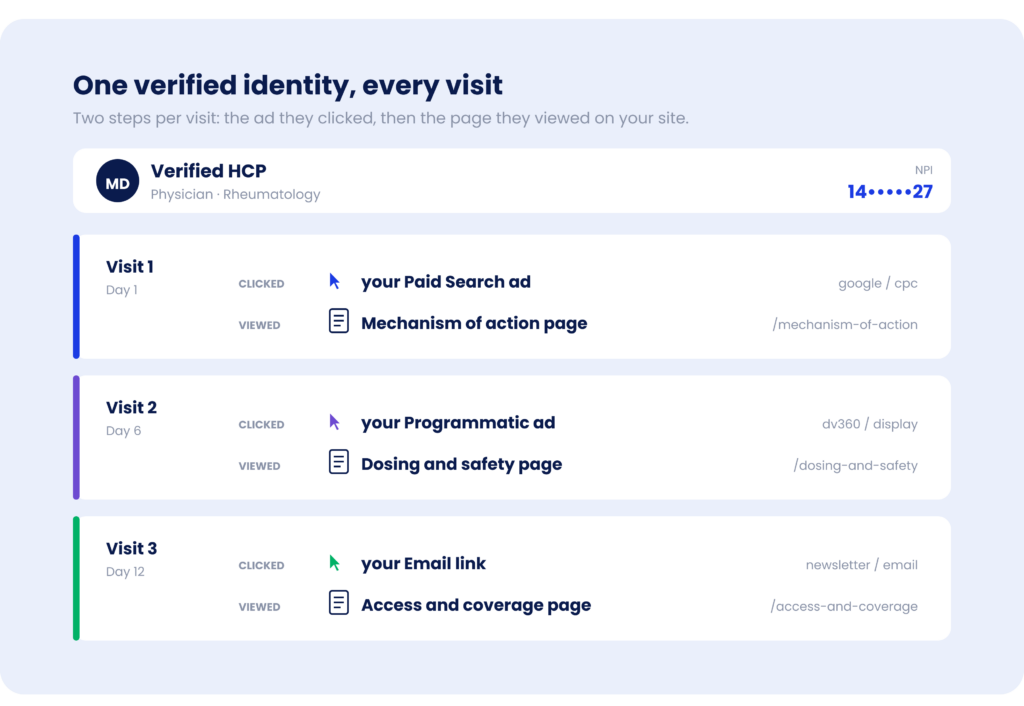
That makes the site your best vantage point. Because the pixel ties each visit, on any channel, to the same verified identity, you can see the pattern over time. What did the provider look at on the first visit. What changed on the second. What did they return for on the third.
That sequence shows how a provider’s understanding is forming. You can order your content to match it. You can measure whether your other channels are actually moving providers back to the site. One identity, every visit, in one view.
Why the Wrango Pixel is different
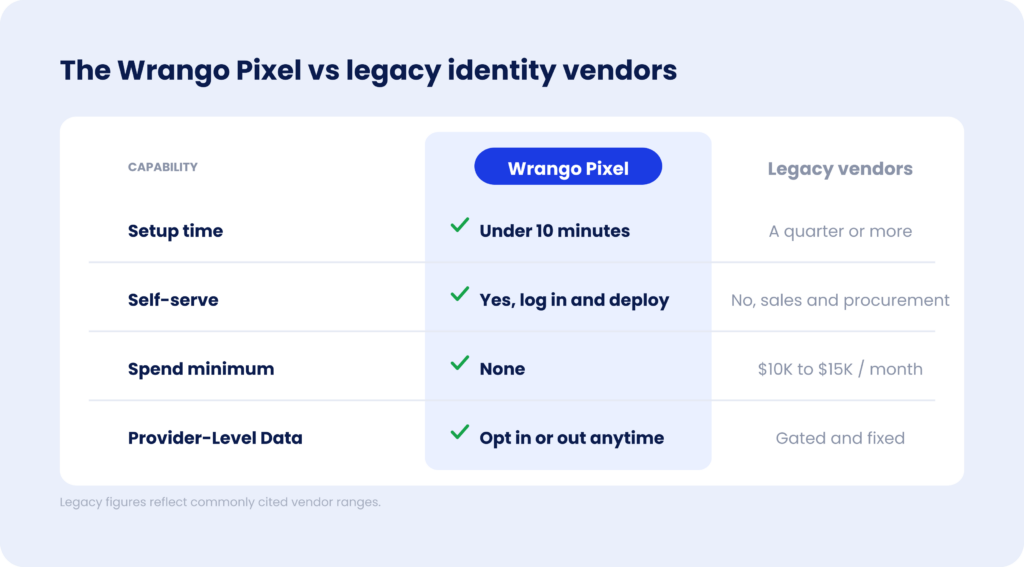
Getting a pixel from a legacy vendor used to mean a procurement cycle, an enterprise contract, and a spend minimum. A decision could take a quarter. Most brands did the math and skipped it.
Wrango removed that gate.
A true self-serve pixel. Log in, generate your tag, deploy it, and start resolving visitors in under 10 minutes. No sales call required.
No minimum fees. No spend minimum to deploy the pixel and start resolving visitors.
Resolution you control. Opt in or opt out of Provider-Level Data resolution whenever you want.
Higher resolution. On live pixels, Wrango resolves around 10 percent of HCP site visitors against a graph of 4.6 million verified NPIs. Legacy identity platforms resolve 1 to 2 percent.
One tag, three outputs. Provider identity from site visits, retargeting audiences built from verified prescribers, and claims enrichment that tells you more about the doctors who visit: their specialty, patient mix, and prescribing context.
Built for compliance. No patient data is collected or shared.
The takeaway
If your site gets traffic and you cannot tell which visitors are physicians, you are not running an HCP campaign. You are running a traffic report.
Put the Wrango Pixel on your HCP domain before your next campaign. See who you actually reach. Feed your sales team and your next-best-action engine. Connect every touchpoint to one provider identity.
Get access to the Wrango platform today
Ready to deploy your pixel? Get access today and we will walk through what it looks like against your brand’s HCP media plan.
Ready to Go?
Connect with our team for tailored HCP insights and a strategic media plan built just for you.
Healthcare marketing is complex, and most platforms don't make it easier to understand what's actually working. Below are answers to the questions we hear most from brand teams and agencies evaluating Wrango, covering how we target, activate, measure, and protect data.
Kseniia Gaskevich
Marketing Manager, WRANGO
April 6, 2026
Sign up and get the latest insights sent directly to your inbox
What is Wrango, and how is it different from other healthcare marketing platforms?
Wrango is a healthcare marketing platform that connects media investment to real-world clinical outcomes. Using Rx and Mx claims and electronic health record data, Wrango enables brands and agencies to identify verified healthcare practitioners (HCPs), activate campaigns across the channels they already use, and measure performance against actual prescribing behavior.
Most platforms rely on proxy signals — historical prescribing lists, specialty codes, or behavioral keyword data — to approximate who they’re reaching. Wrango takes a different approach. Instead of inferring intent from browsing patterns, we build audiences from real clinical activity: diagnoses, treatments, and patient interactions. That means campaigns reach verified, practicing clinicians and are evaluated on outcomes, not assumptions.
How does Wrango fit into an existing media buying workflow?
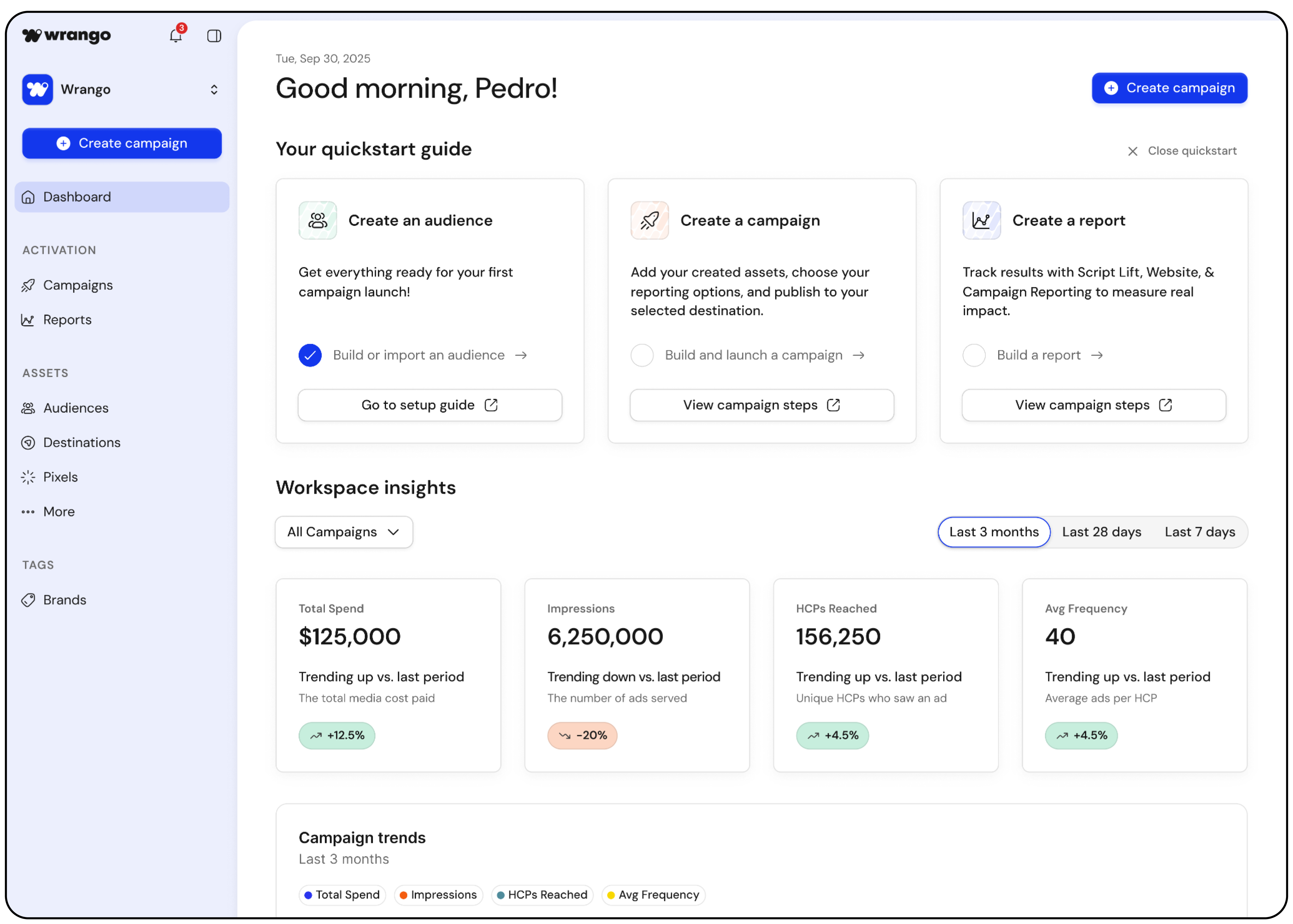
There’s no need to change how you plan, buy, or measure campaigns. From a single interface, teams can build audiences, launch campaigns, and track performance while continuing to use the DSPs, search platforms, and social channels they already rely on.
Wrango integrates directly with the platforms you already use, so you can deploy one verified HCP audience across channels without rebuilding activation workflows.
Build audiences, activate campaigns, and track performance across all your channels from a single interface.
Can I use my existing CRM or sales rep lists in Wrango?
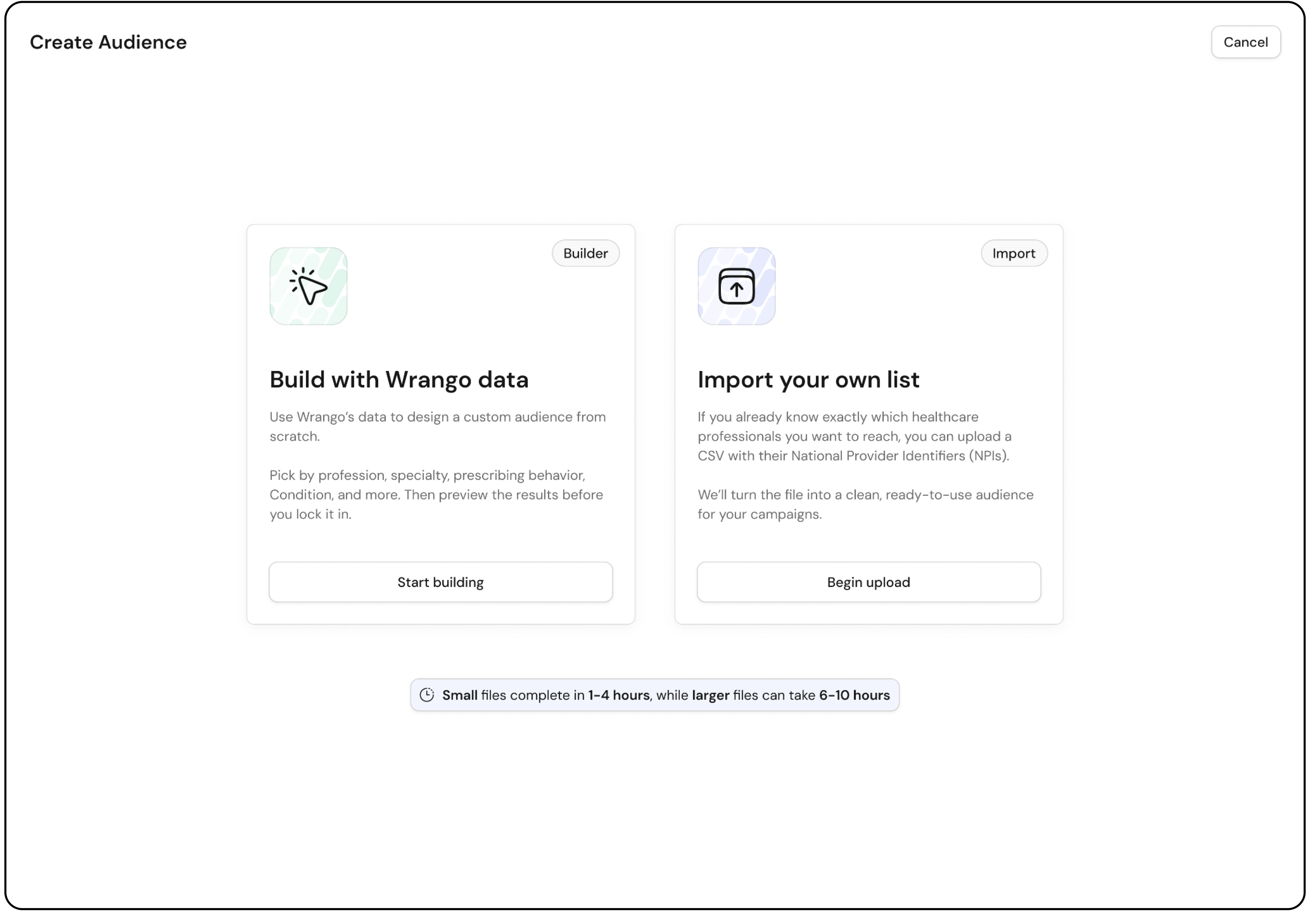
Yes. You can onboard your CRM or NPI lists directly into Wrango. Once uploaded, those lists are matched to verified HCP profiles and enriched with real-time clinical signals — transforming static data into live, addressable audiences mapped to actual digital identifiers.
You can also build net-new audiences from clinical activity, apply recent lookback windows, prioritize high-value prescribers, and exclude existing writers to focus spend on growth.
Upload your existing CRM lists or build custom audiences from Wrango data, all in one place.
How does Wrango verify that a profile belongs to a real HCP?
When an HCP registers through one of Wrango’s partner platforms, their profile is cross-referenced against multiple sources to confirm they are a credentialed, practicing professional:
NPI registries or Provincial licensing registries
Independent healthcare databases
Multiple external sources for redundancy
From there, targeting is deterministic, not probabilistic. Every ad delivery is tied to durable, verified identifiers:
Verified email
Authenticated platform matching via Google and Meta
Known publisher environments
That means every impression reaches a real HCP, not a best guess based on browsing behavior.
How does Wrango identify which providers are “in-market”?
Wrango detects in-market providers by analyzing what’s happening within their patient populations in near real time. By looking at clinical signals — recent diagnoses, procedures, lab tests, and treatment activity — across a physician’s patient base, Wrango can identify when a provider is likely to be actively evaluating or prescribing treatments for a given condition.
This moves targeting from “who prescribed this drug two years ago” to “who is managing patients right now who need this therapy.”
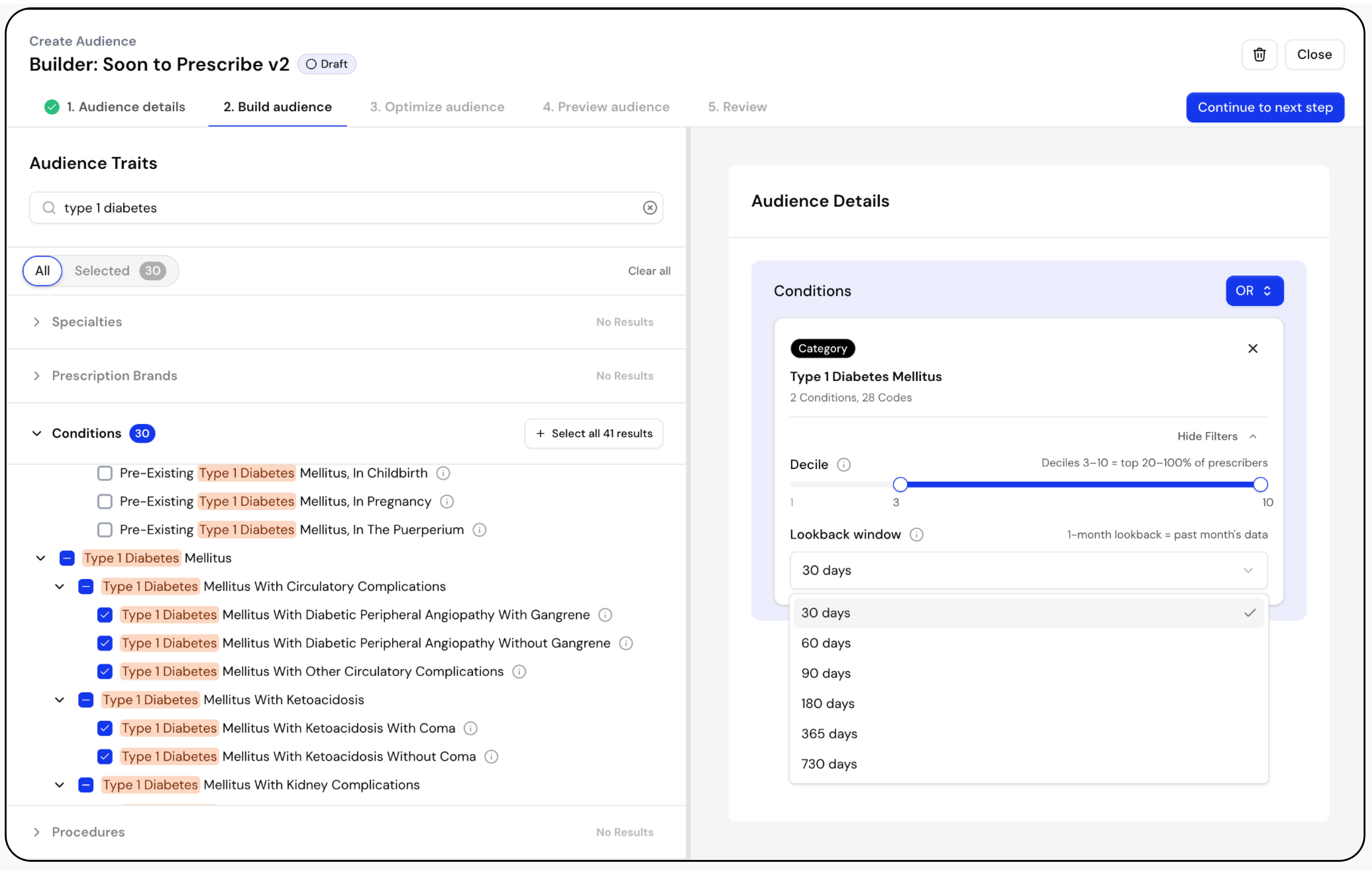
Filter by prescription brand, decile, and lookback window to reach providers actively managing relevant patients right now.
How frequently are audiences refreshed?
Audiences are refreshed monthly based on the latest clinical activity, including diagnoses, treatments, and patient interactions. Campaigns always reflect current behavior, not historical snapshots.
What does Wrango measure beyond standard media metrics?
Wrango measures what happens after exposure in terms that matter to healthcare marketers: changes in prescribing behavior. Campaigns are evaluated against metrics including:
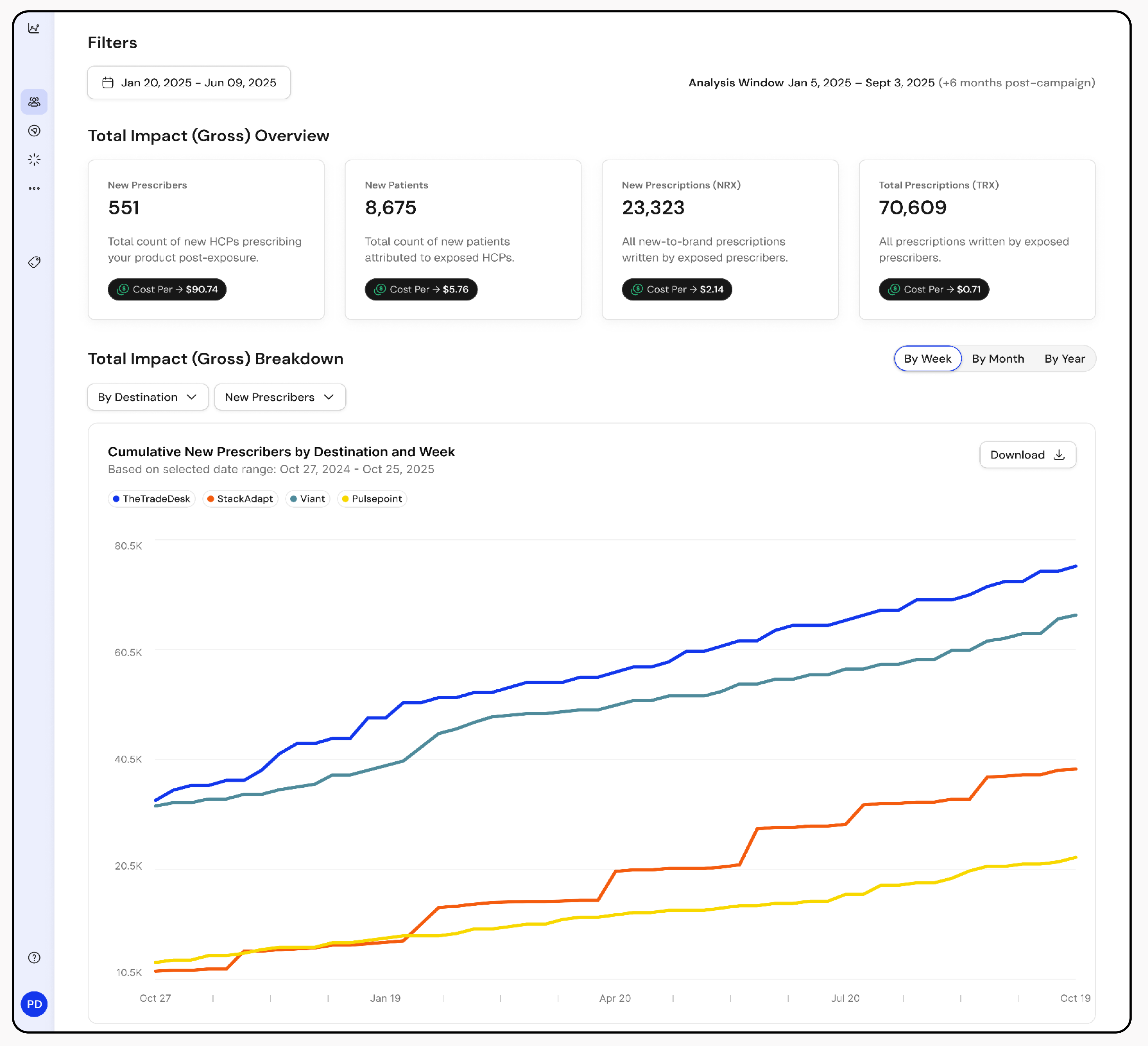
New prescribers — providers who began writing scripts after exposure
New patients — incremental patient starts attributable to the campaign
Total prescription volume — overall change in Rx over the campaign window
Prescribing trends over time — whether behavior is sustained or a one-time lift
Wrango connects every media exposure to real prescribing outcomes, giving you physician-level visibility into what’s actually working.
This gives marketing teams physician-level visibility into campaign impact, not just impressions and clicks.
Wrango also supports physician-level data (PLD) measurement across Search and Social specifically. This works by placing a website pixel that captures on-site activity and connects it back to verified HCP profiles, so you can evaluate outcome-based performance on those channels rather than relying on the limited reporting native platforms provide.
What is “script lift,” and how is it calculated?
Script lift is how Wrango quantifies the incremental impact of a campaign on prescribing behavior. Here’s how it works in practice:
Wrango identifies two groups of providers matched on specialty, geography, and historical prescribing patterns — one group exposed to the campaign, one not. At the end of the measurement window, we compare prescribing rates between the two groups. The difference is the lift: what changed because of the media, isolated from background noise.
For example, if exposed providers write an average of 12 new scripts per month versus 9 for the control group, that 3-script difference represents a 33% lift attributable to the campaign — not market trends, not seasonality, not coincidence.
Script lift is calculated by comparing prescribing behavior between exposed providers and a matched control group, isolating exactly what your campaign moved.
How does Wrango get consent and meet compliance standards?
HCP data is only used with explicit, informed permission. Practitioners opt in through trusted partner platforms using transparent consent mechanisms that clearly disclose how data will be used, for what purposes, and which partners are involved. HCPs can withdraw consent at any time, and those requests are enforced across all systems and activation environments.
At the core of the platform is a consented HCP identity graph. Every audience, activation, and measurement workflow is grounded in privacy-first data. Wrango is built to meet the compliance standards healthcare marketers require:
SOC 2 Type II certified, with independently audited controls
HIPAA-compliant infrastructure for handling sensitive healthcare data
Strict data minimization and governance practices
Contractual protections across all data partners
Audit-ready consent and data usage records
Where can I activate Wrango audiences?
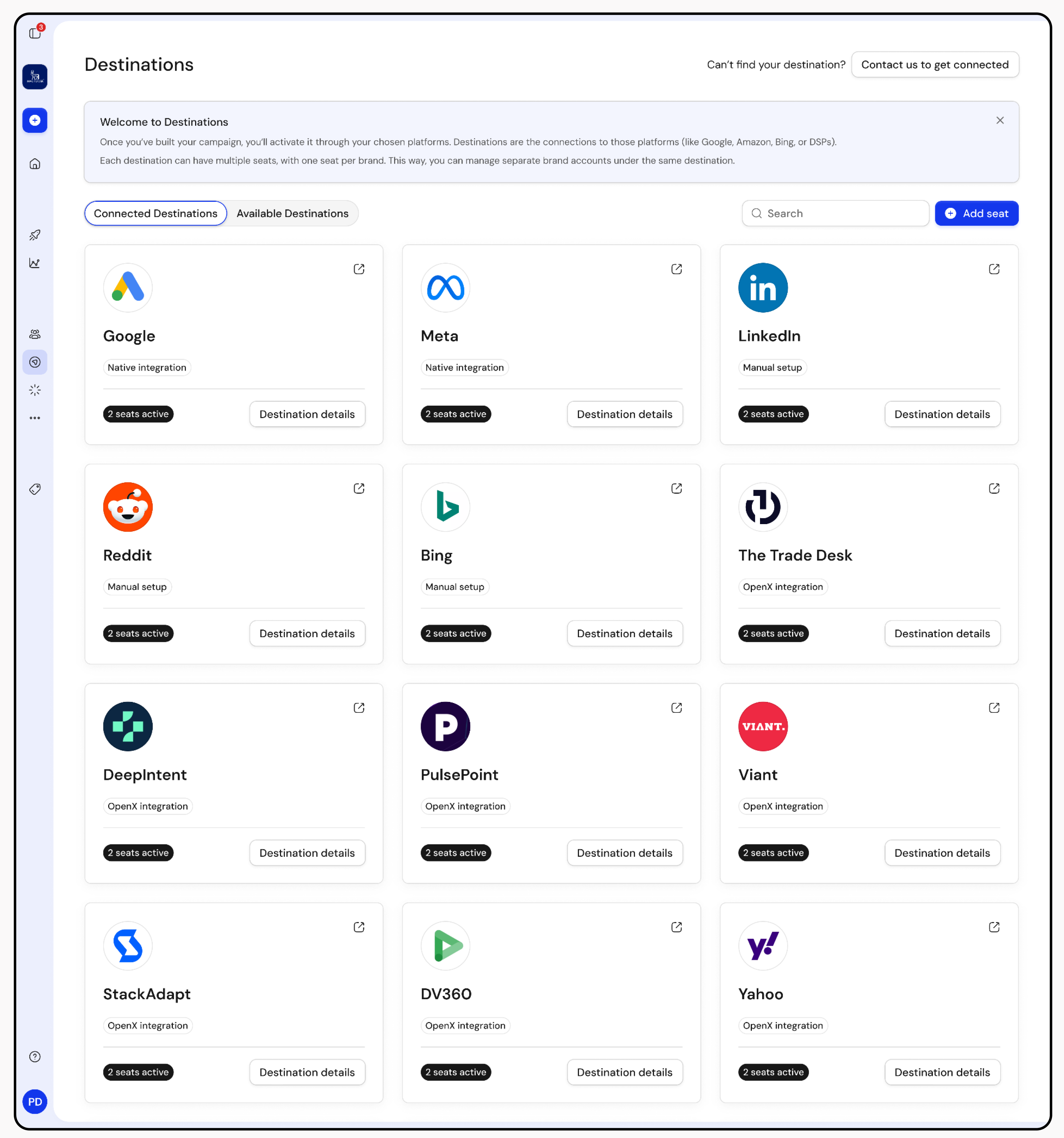
Wrango audiences can be activated across 25+ programmatic and walled-garden destinations, including Google, Meta, TTD, LinkedIn, Bing, TikTok and Reddit. Activation is available self-serve or managed, with no additional setup required and always in your owned platform seats.
If a destination isn’t currently listed, Wrango’s native identity graph supports fast custom integrations. Contact the team to enable new environments.
One audience, deployed across every major programmatic and walled-garden destination you already use.
How quickly can I get started with Wrango? Are there minimum spend requirements?
Most campaigns are set up and live within days to a week, depending on audience and platform requirements. There are no minimum spend commitments, so teams can test, learn, and scale based on their goals.
Ready to Go?
Connect with our team for tailored HCP insights and a strategic media plan built just for you.
Healthcare Advertising Has an Attribution Problem. We Built Past It.
Healthcare marketers are working with attribution tools that too often miss the mark. Understanding whether advertising changes prescribing behavior requires systems built specifically for healthcare’s realities.
Prithvi Pradip
Engineering Lead
March 9, 2026
Sign up and get the latest insights sent directly to your inbox
When a pharmaceutical brand invests millions into digital advertising, they’re ultimately asking one question: did this campaign change prescribing behavior? In healthcare, that answer is genuinely difficult to get.
Unlike consumer marketing, where a click can quickly lead to a purchase, healthcare decisions unfold over weeks or months and across disconnected systems. Ads are served in one environment, website visits happen in another, and prescriptions appear later in claims data. Most attribution models weren’t designed with that kind of timeline in mind.
At Wrango, we built an attribution system specifically for healthcare. The goal was to go beyond connecting impressions to clicks, and instead connect exposure to real-world prescribing outcomes.
Why Healthcare Attribution Breaks Down
There are three characteristics of healthcare that standard attribution tools tend to struggle with.
Shared environments. Hospitals and large practices often route many clinicians through the same networks. This makes IP-based attribution unreliable on its own, since a single IP address can represent hundreds of different providers.
Long decision cycles. A physician may encounter an ad today, visit a product site weeks later, and write a prescription months after that. Short attribution windows are not a great fit for a decision process that unfolds over that kind of timeframe.
Privacy requirements. Healthcare data requires careful handling and user consent, which shapes how identity can be captured and resolved. Tools built for consumer contexts often don’t translate cleanly here.
These aren’t edge cases. They’re the norm in healthcare, and any measurement approach needs to account for them.
A Layered Approach to Identity and Outcomes
Rather than relying on a single signal, Wrango combines multiple layers, each designed with these healthcare-specific constraints in mind.
The first layer uses deterministic device identifiers and email-authenticated events that can be resolved to individual healthcare providers. Where this is possible, it gives us high-confidence matches for known audiences.
Where direct identity resolution isn’t available, we use behavioral signals that connect website visits back to prior ad exposures. This happens within a scoped and controlled context, limited to the correct brand and pixel, which helps keep false positives low.
The third layer is prescription claims data paired with control groups. For every provider who was exposed to a campaign, we compare their prescribing behavior against a matched peer who wasn’t. This is what moves measurement from correlation toward something closer to causation.
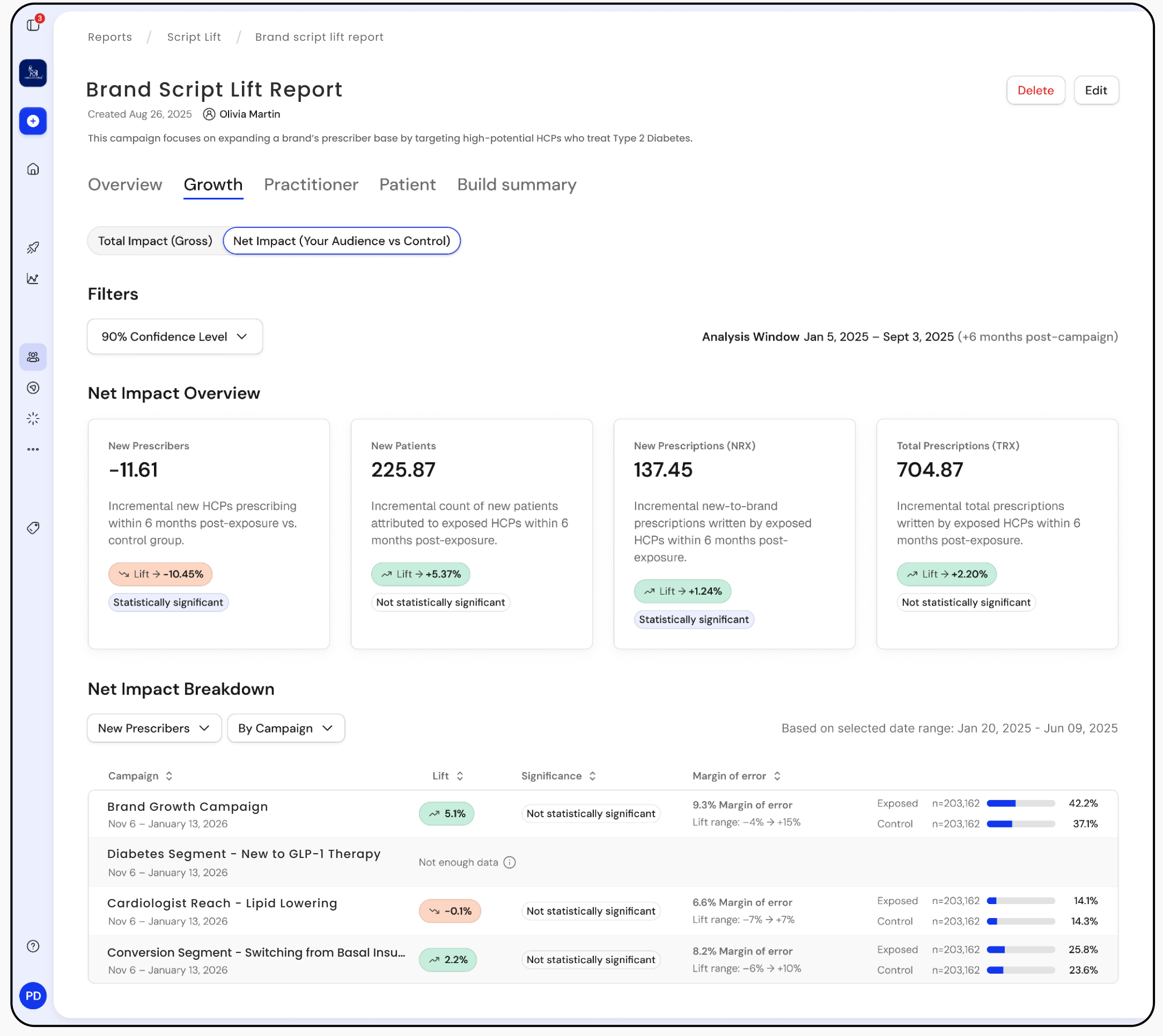
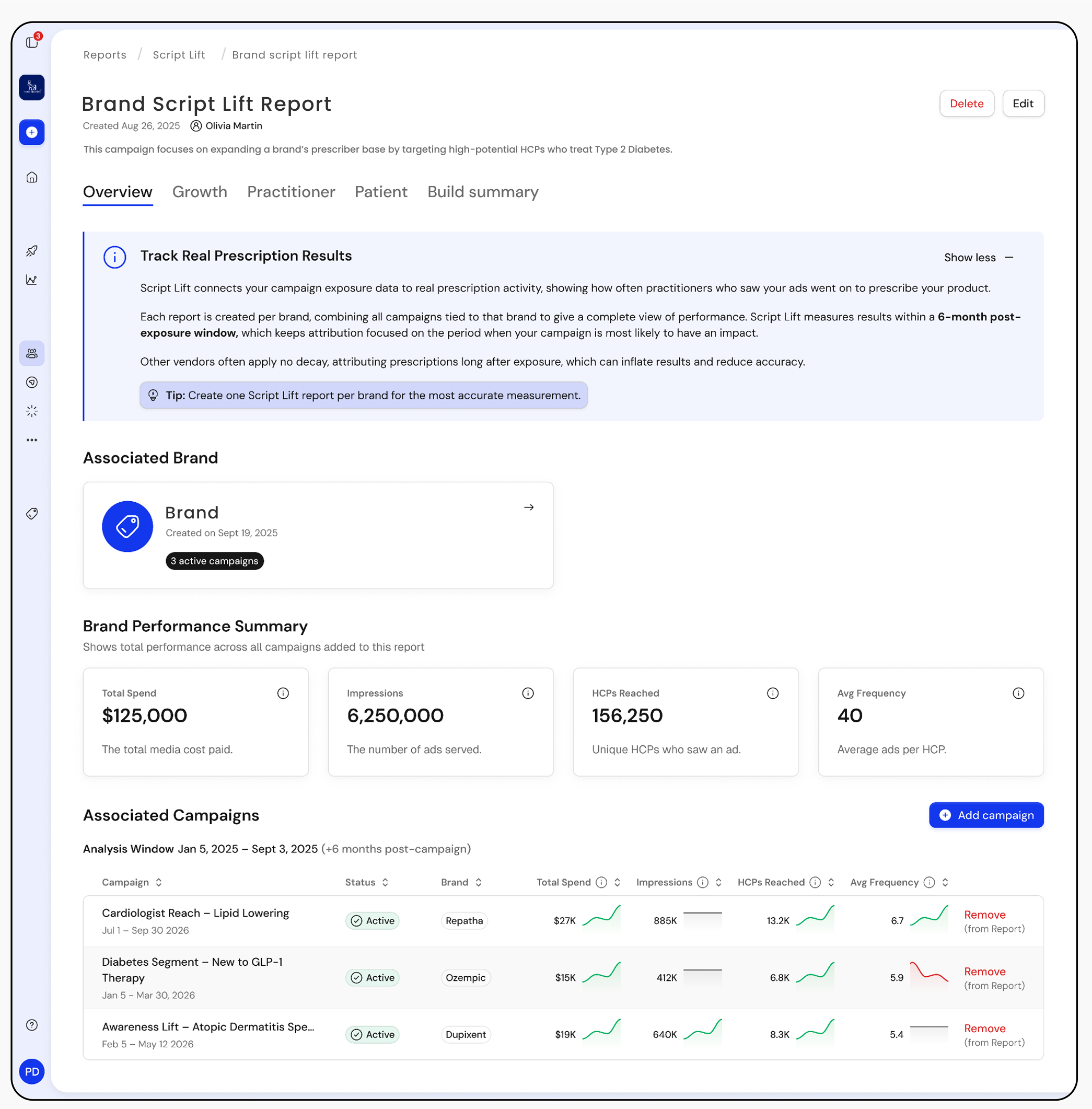
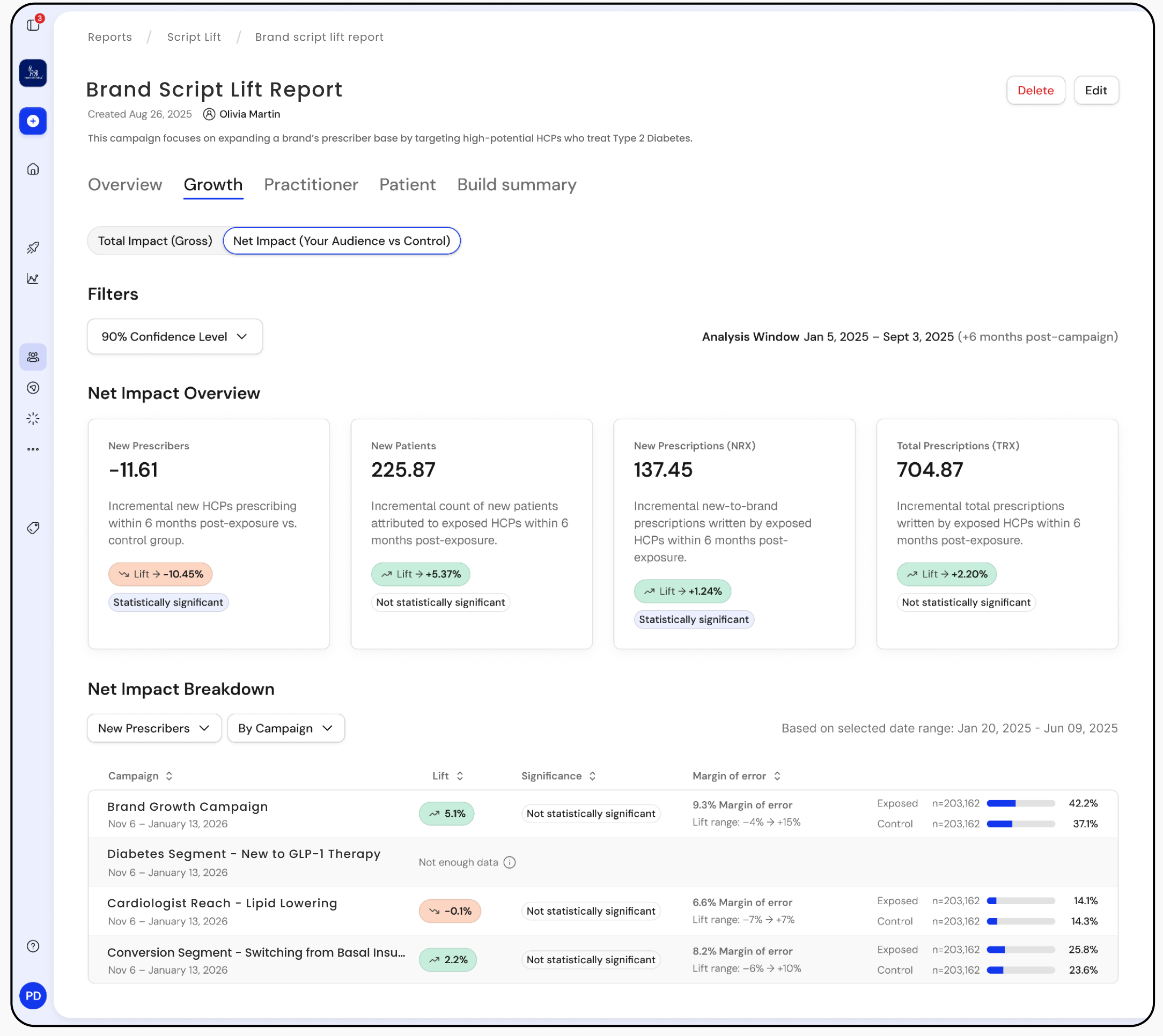
All campaigns, all DSPs, one report. Wrango’s Script Lift view consolidates exposure across every linked campaign into a single brand-level picture, with an attribution window built to reflect how healthcare decisions actually unfold.
Healthcare campaigns typically run across multiple platforms, which creates a practical challenge: stitching together reports from different DSPs makes it hard to deduplicate reach, compare performance consistently, or see the full picture in one place.
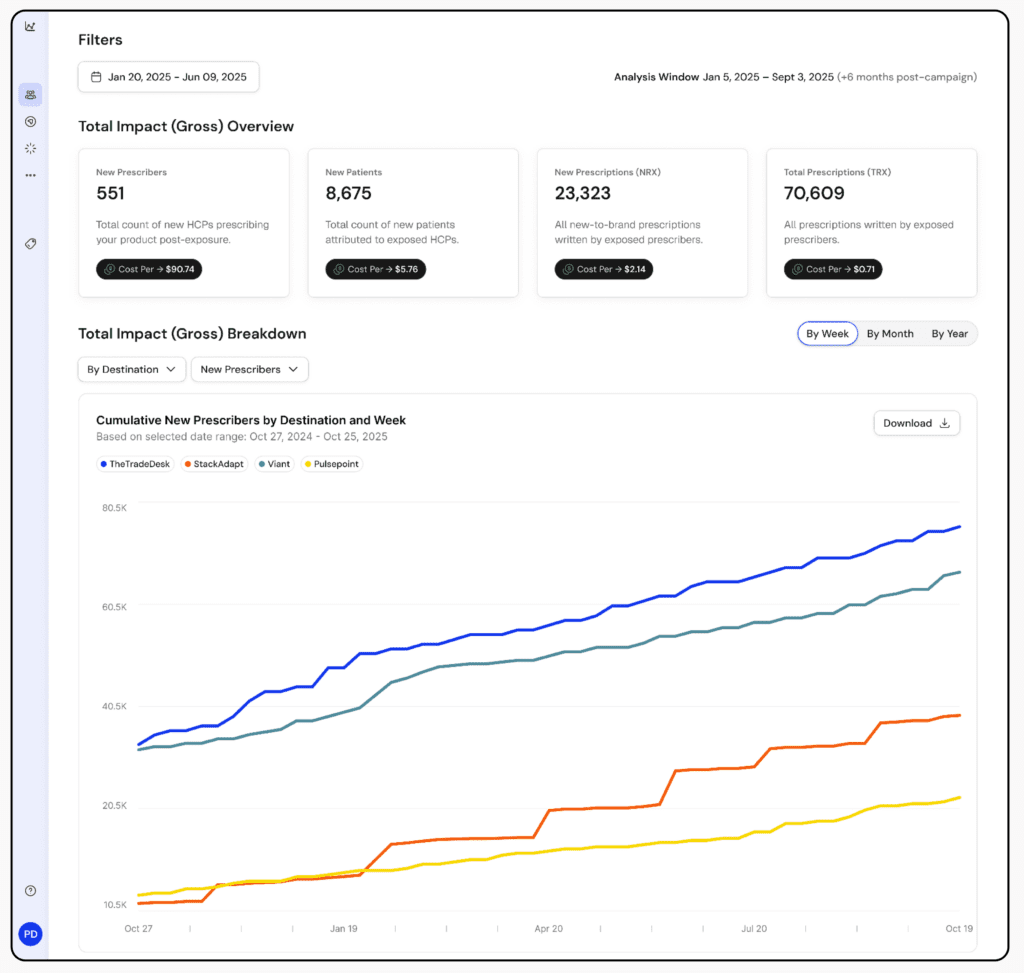
New prescribers tracked cumulatively across DSPs are deduplicated across all campaigns linked to a single report.
Measuring What Actually Matters
Attribution tells you who saw an ad. Lift measurement tells you whether the campaign had any effect on behavior isolated from everything else your brand is doing to convert prescribers. They’re related but distinct questions.
The reason the distinction matters is that without a control group, it’s easy to overestimate impact. If a campaign reaches physicians who were already likely to prescribe, the numbers can look strong even if the advertising had no real influence. Comparing against a matched unexposed group is what makes it possible to separate genuine lift from background prescribing patterns.
Did the campaign change prescribing behavior? Wrango’s Script Lift report compares exposed physicians against a matched peer group to show the real difference the campaign made.
Healthcare marketers deserve the same quality of measurement that consumer brands have come to expect, adapted for healthcare’s longer timelines, data requirements, and regulatory environment.
The Takeaway
Measuring campaign impact in healthcare requires infrastructure built for:
Long decision cycles
Shared clinical environments
Strict privacy standards
Real-world prescription validation
Getting to a reliable answer on prescribing lift takes more than a standard attribution model. It takes a system designed around how healthcare actually works. That’s what we focused on building at Wrango.
Learn More
If you’re evaluating how your campaigns measure prescribing lift, it may be time to rethink whether your attribution model reflects healthcare’s realities.
Stop Targeting the Entire Market. Start Targeting Soon-to-Prescribe Audiences.
Most pharma campaigns target the entire market. This leads to significant budget waste. Here’s why brands should shift their focus to physicians who are actively treating relevant patients with Soon-to-Prescribe Audiences.
Manar Abbas
Director of Client Partnerships and Strategy
February 27, 2026
Sign up and get the latest insights sent directly to your inbox
Most pharma campaigns are built to reach the entire market of potential prescribers. They use broad audience catalogues, which capture every health care professional (HCP) who prescribed in their pharmacological class in the last two years, regardless of whether they have a relevant patient today.
At best, the result is diluted impact. At worst, this leads to massive budget waste.
By analyzing electronic health record (EHR) and claims data, Wrango enables pharma marketers to reach HCPs who are actively managing therapy-relevant patient cases. Instead of targeting everyone who has prescribed in a category, marketers can focus on physicians currently diagnosing and treating qualified patients through Soon-to-Prescribe Audiences.
What are Soon-to-Prescribe Audiences?
Soon-to-Prescribe Audiences identify healthcare practitioners (HCPs) who are likely to prescribe a specific therapy class in the near term based on recent clinical activity from patients under their care.
These audiences are built using real patient-level clinical signals (recent diagnostic tests, procedures, and diagnoses) that indicate active management of conditions associated with a given pharmacological class. By analyzing the recency, combination, and clinical relevance of these events, patterns emerge that are strongly correlated with near-term prescribing behavior.
By linking these clinical signals directly to the treating provider, Soon-to-Prescribe Audiences surface HCPs who are actively managing patients whose clinical profiles align with the use of specific therapies. This shifts targeting from historical prescribing patterns or broad specialty assumptions to present clinical momentum.
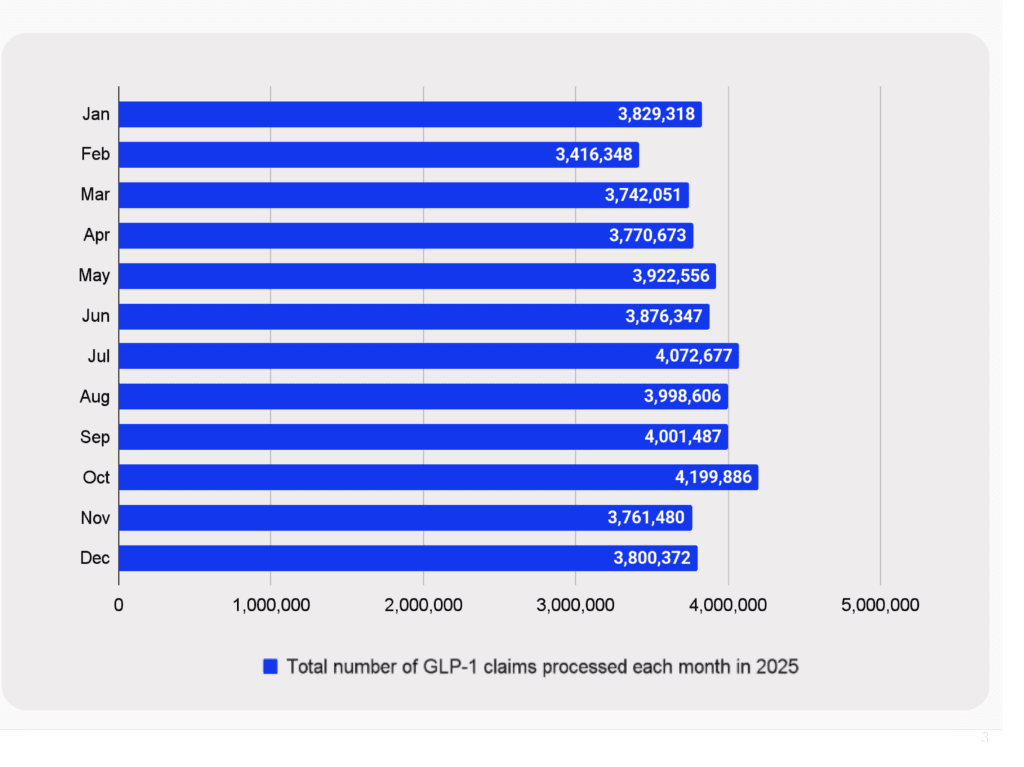
This distinction becomes clear when you look at real-world prescribing volume. For example, we witness over 3,000,000 GLP-1 claims every month across our dataset. This is the outcomes data from which we reverse engineer Soon-to-Prescribe Audience targeting.
More than 3 million GLP-1 claims are processed monthly. By reverse engineering claims data, we identify the behavioral patterns and patient signals that precede prescribing decisions.
Why Historical Prescribing Data Falls Short
Prescribing behavior is uniquely event-driven. Contrast this with other types of consumers: someone who’s purchased running shoes from Nike before is likely to purchase from them again next time they’re in the market. But a physician doesn’t prescribe because they did so 18 months ago. They prescribe because a patient sitting in front of them today has a specific clinical need.
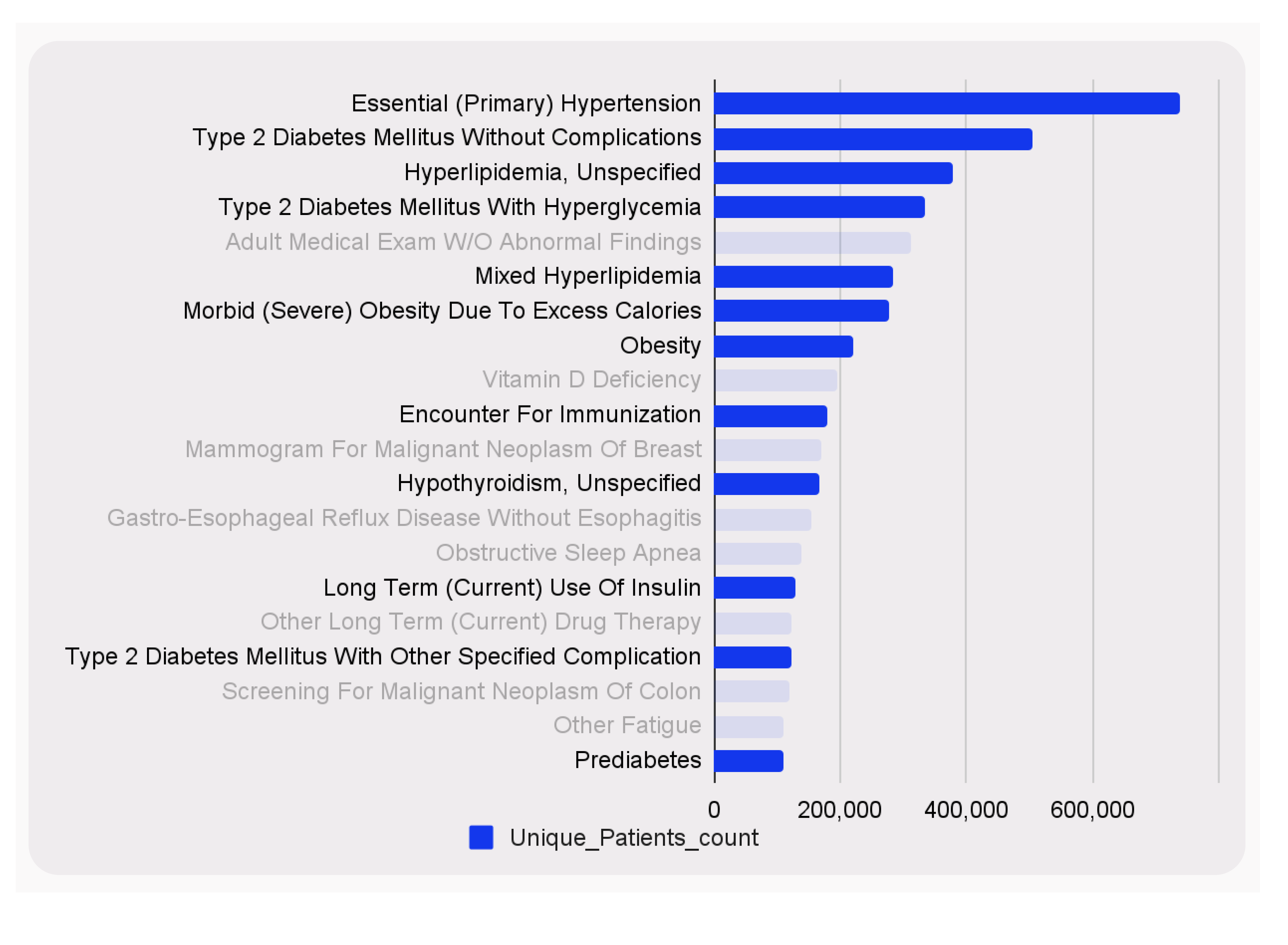
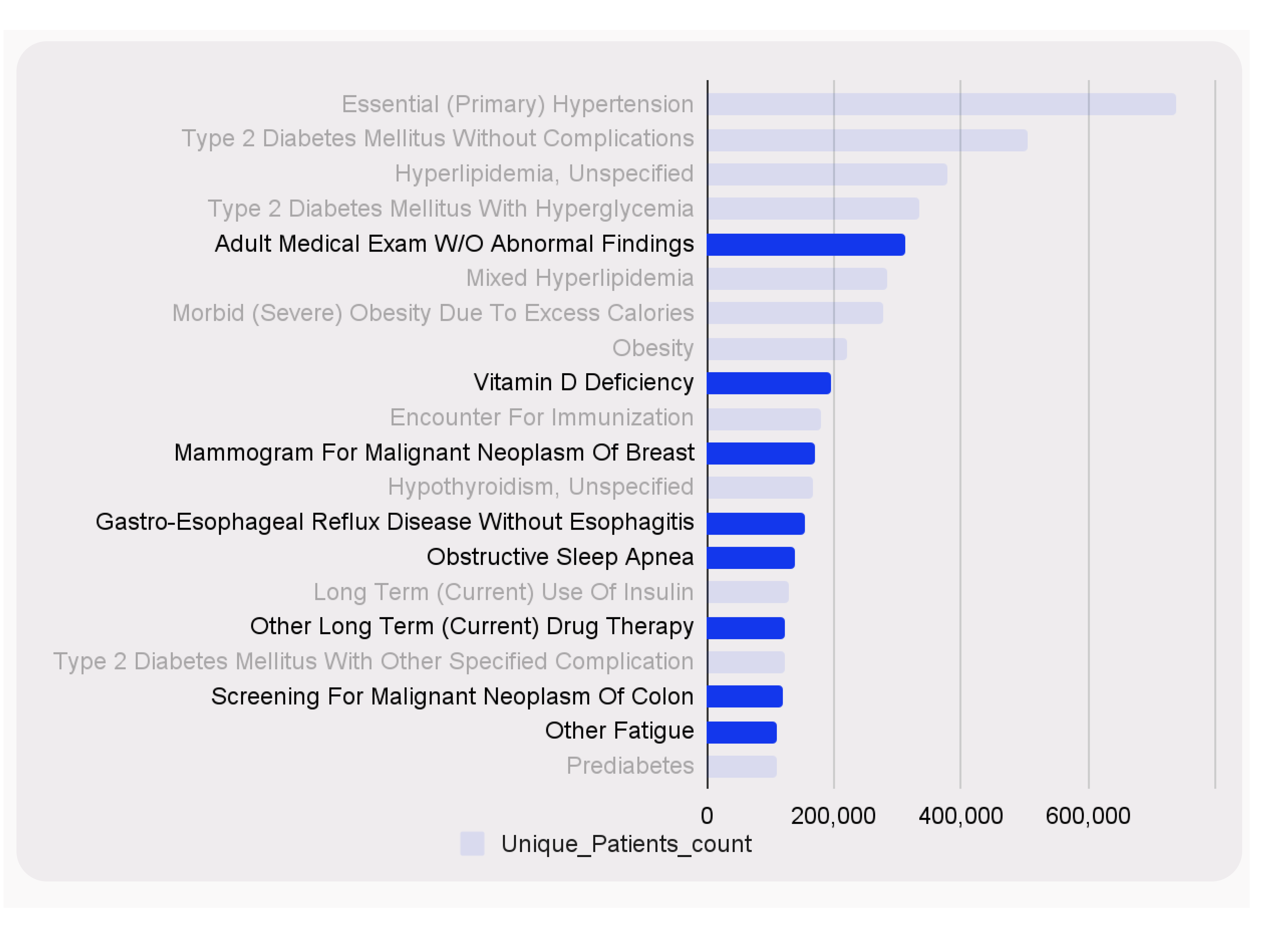
Take GLP-1 therapies as an example. Patients with overlapping aspects of metabolic syndrome—such as type 2 diabetes, hypertension, hyperlipidemia, obesity, and insulin resistance—have a strong association with GLP-1 prescriptions. A physician treating patients who exhibit several of these signals is significantly more likely to initiate GLP-1 therapy in the near term.
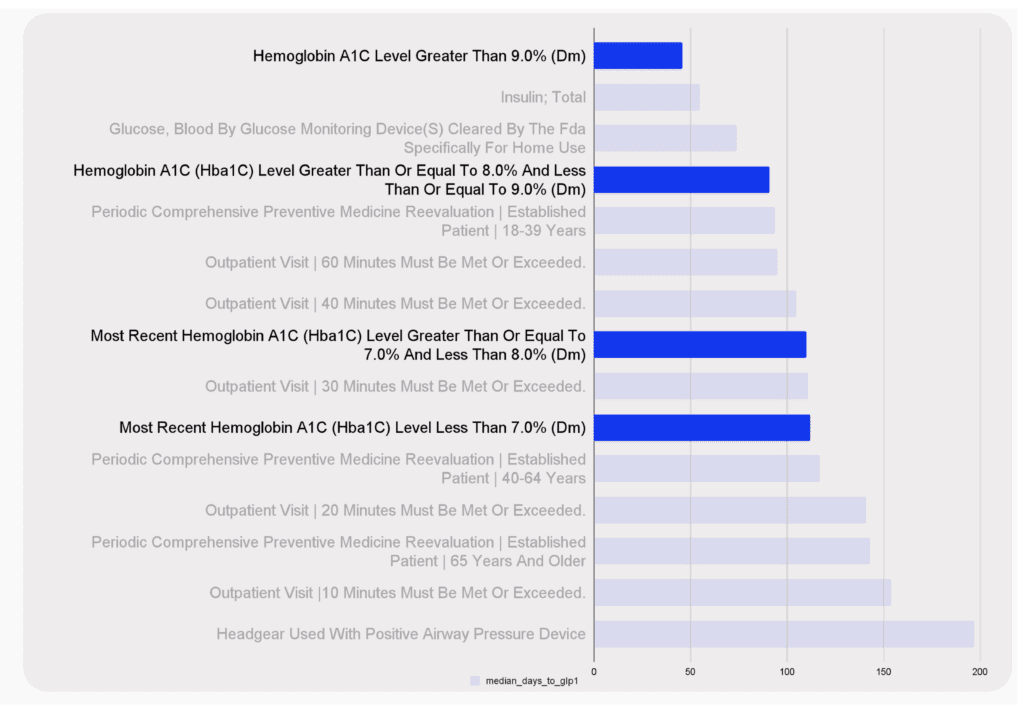
Timing sharpens this further. If a patient’s most recent Hemoglobin A1C is greater than 9.0%, they are, on average, roughly 45 days away from a GLP-1 prescription.
The result is an in-market audience built around current clinical momentum. Soon-to-Prescribe Audiences enable pharmaceutical brands to prioritize the HCPs most likely to prescribe next—improving campaign efficiency, accelerating therapy adoption, and driving measurable impact.
AI reveals strong overlap between metabolic syndrome indicators and GLP-1 prescribing. Hypertension, Type 2 Diabetes, hyperlipidemia, and obesity consistently lead confirming that prescribing is driven by active clinical signals, not historical scripts.
AI also surfaces non-obvious signals, like sleep apnea, that correlate with GLP-1 prescribing beyond traditional metabolic indicators.
Elevated A1C levels signal immediate treatment momentum. Patients with A1C ≥9.0% are significantly closer to GLP-1 initiation, allowing models to prioritize HCPs at the point when prescribing decisions are actively forming.
Soon-to-Prescribe Audiences fundamentally change how pharma marketers engage, measure, and scale. Key benefits include:
Engaging prescribers at the moment of opportunity. Reach HCPs who are actively treating patients whose clinical profiles align with your therapy class during the window when treatment decisions are forming.
Improving efficiency and relevance. Focus investment on providers with current clinical signals indicating near-term prescribing potential, rather than broad historical segments.
Accelerating adoption among new prescribers. Identify future prescribers before the first prescription is written by analyzing the clinical patterns that precede therapy initiation.
Powering targeting and measurement from the same source of truth. In pharma, claims data is outcomes data. By building audiences and measuring performance directly against real-world prescribing activity, campaigns are optimized to the business results that matter.
Moving faster with centralized intelligence. When outcomes data is native to audience modeling, insights can be refreshed and distributed across channels without manual stitching or delayed validation.
The result is a marketing strategy aligned with real prescribing behavior, engaging the right HCPs, at the right moment, with measurable clinical impact.
In our GLP-1 example, a two-year prescriber lookback yields ~435,000 HCPs. That audience includes many physicians who simply do not have a patient need right now.
We tested applying:
Recent patient-level clinical signals
Diagnosis overlap and comorbidity patterns
Severity indicators (e.g., elevated A1C levels)
Recency-based timing windows
New prescriber definitions tied to therapy initiation
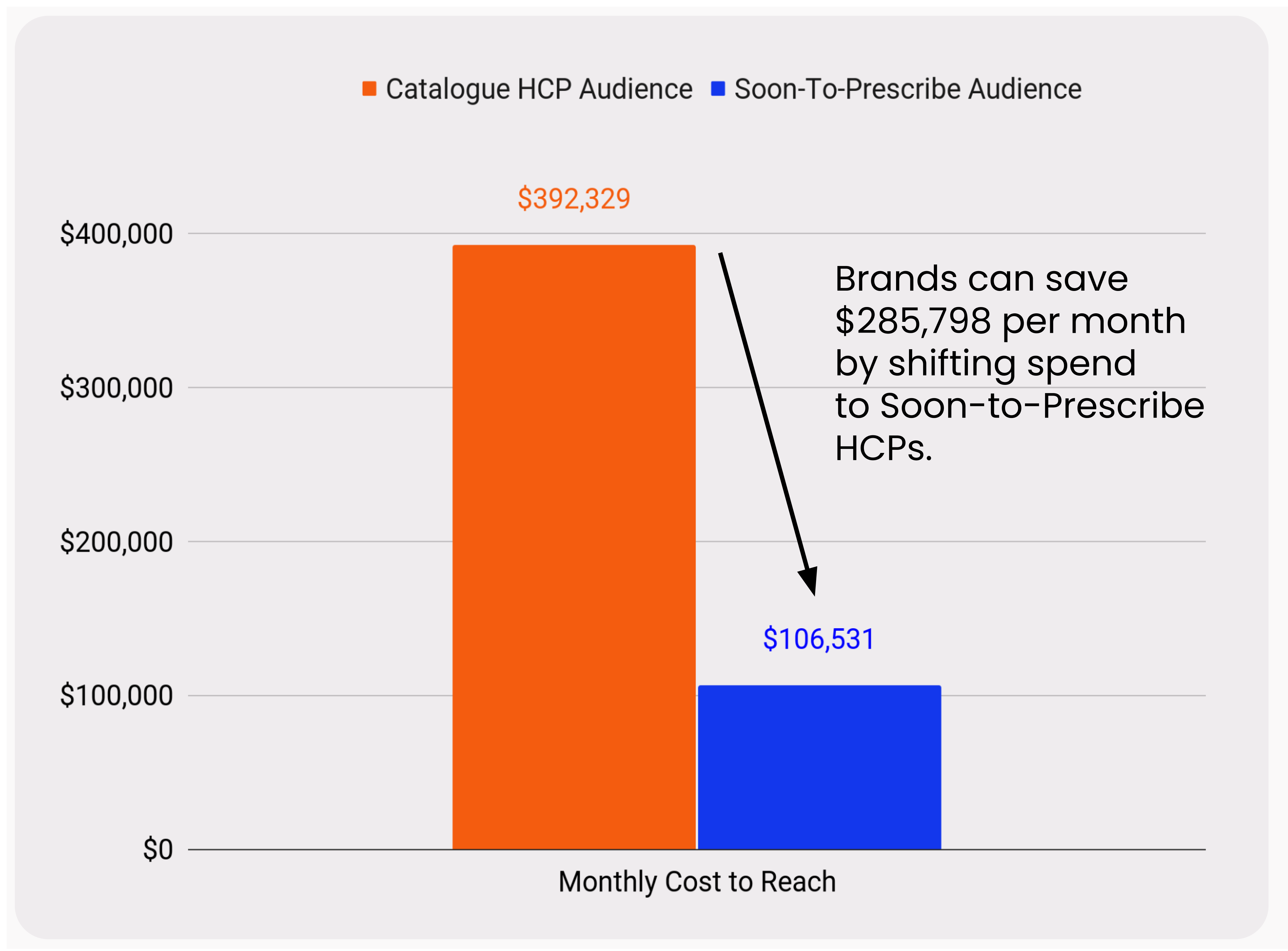
In doing so, we reduced that pool to ~118,000 HCPs actively treating patients likely to initiate therapy in the near term. In this case, that meant avoiding approximately $285,798 in monthly spend directed at physicians who were not in-market..
Without patient-level signal refinement, most budget goes to historical prescribers. Using real-time diagnosis triggers shifts spend toward physicians actively managing therapy-relevant cases.
The Takeaway
Audience-based targeting flips the model.
Stop doing this:
Targeting everyone who prescribed in the last two years
Refreshing audiences twice a year
Measuring CTR as a proxy for success
Start doing this:
Defining audiences based on real-world clinical timing
Modeling severity and recency signals
Refreshing segments automatically
Aligning spend to who is in-market now
The difference between “the market” and “in-market” is the difference between waste and efficiency.
Learn More
If your display budget is fixed each month, the question isn’t how many HCPs you can reach, but whether you’re reaching the right ones at the right moment.
Connect with our team to explore in-market HCP modeling powered by real-world claims data.
Ready to Go?
Connect with our team for tailored HCP insights and a strategic media plan built just for you.
Why Keyword Targeting Alone Fails Pharma Marketers on Search
Like many advertisers, pharma marketers running search campaigns leverage keywords to find relevant audiences. However, for pharmaceuticals in particular, keywords aren’t very good at predicting if the audience is a practitioner or a patient. Indeed, many people search healthcare-related keywords, including patients, caregivers, and students. This article breaks down why keywords create the illusion of precision, and what audience-first strategies make possible instead.
Shafi Sultan
VP of Platform Enablement
February 9, 2026
Sign up and get the latest insights sent directly to your inbox
While every search campaign leverages keywords to reach relevant audiences, in the case of pharmaceutical advertising, keywords alone may lead to false positives. In practice, keyword targeting captures interest, not identity.
Patients, caregivers, students, and researchers all search the same terms as prescribers. When campaigns are built around keywords alone, pharma marketers aren’t targeting health care professionals (HCPs), but rather anyone who happens to type the right words into a search bar.
Audience targeting is a much better way for pharmaceutical marketers to reach the individuals making prescribing decisions.
Why Audience Targeting Is Not Widely Used in Pharma Search
Keywords have long been pharmaceutical marketers’ only lever to pull in search campaign targeting. Up until very recently, it was the only targeting option Google provided for “sensitive category” advertisers like pharma.
Over time, this structural constraint became the operating default. Despite the fact that Google has rolled out new targeting capabilities for HCP campaigns, many pharma advertisers are still stuck with tools that adhere to outdated, keyword-only targeting in search. Worse, they aren’t aware that there is a more effective way to find HCPs via search.
Why This Is a Pressing Problem For Pharma Advertisers
While Google now allows advertisers to build and certify a unique ad account specifically for HCP campaigns and enable custom match audiences, too few pharma advertisers activating search campaigns on Google are using this functionality. As a result, only a fraction of a brand’s current paid Google traffic to HCP domains actually reach HCPs.
To illustrate the problem, we recently audited a brand’s website. For the sake of anonymity, we are going to obscure some numbers but keep the integrity of the analysis as a demonstration.
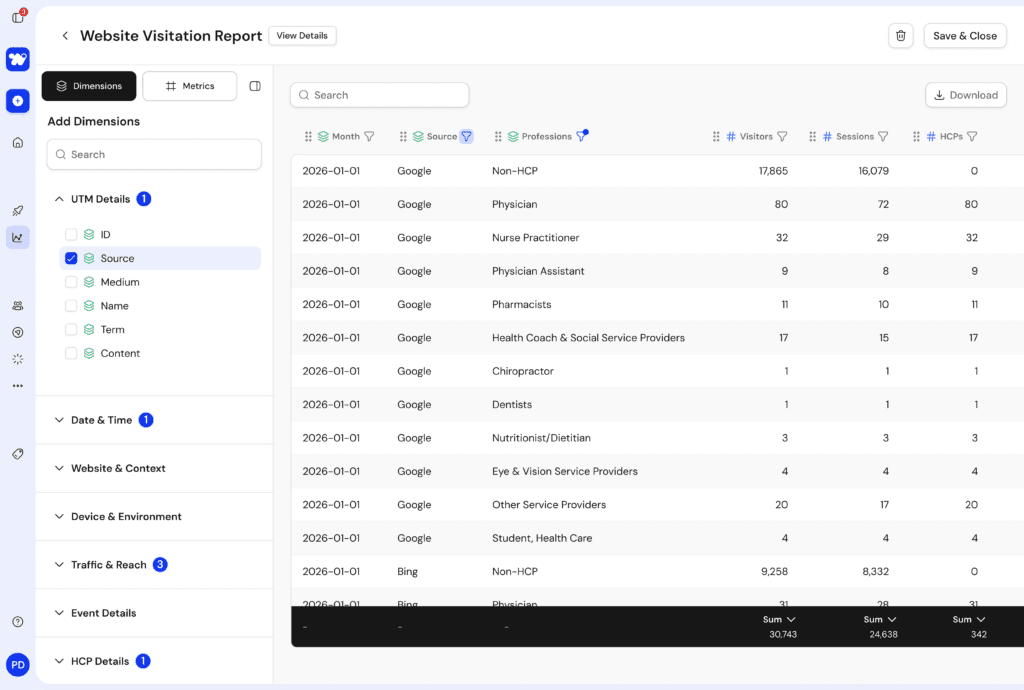
Within a one-month period on this brand’s HCP domain, 18,177 visitors arrived via UTMs tagged as Paid Search. Of that traffic, only 312 visitors (1.7%) could be verified as healthcare professionals. Among those verified HCPs, just 167 (54%) were core prescribers, defined as physicians, nurse practitioners, physician assistants, and pharmacists, meaning that less than 1% of total Search traffic ultimately reached the intended prescribing audience.
The Hidden Cost of Keyword-Based Targeting
When a majority of the search budget intended for HCPs doesn’t actually reach providers, it unintentionally slips from a specialized snipe to a broad DTC play.
Let’s go back to this same brand website example. If 18,177 visits came from Paid Search and the average CPC in the pharmaceutical category ranges between $6 and $8 USD, the brand likely spent approximately $109,062–$145,416 per month. Of that spend, only about $3,876–$5,168 reached verified HCPs, and even less, approximately $1,722–$2,296, reached core prescribers.
The consequences of this are multifold:
Massive budget wasted on the wrong audience and expensive pharma keywords
Performance is judged without knowing who was actually reached
Learning cycles may reinforce campaign elements that work on consumers, but don’t move the needle on HCPs
By ensuring your search budget is truly reaching HCPs, advertisers can properly allocate budgets, trust their insights, and optimize campaigns based on reliable signals.
How Audience-Based Targeting Changes the Equation
Audience-based targeting flips the model.
Instead of guessing based on keywords, marketers start with verified prescribers. They learn the searches, phrases, and paths physicians, nurses, physician assistants, and other HCPs actually use, and how those journeys differ by role.
In the Wrango platform, HCP audiences are built using real-world claims and EHR data tied to persistent identifiers like hashed email and MAID. That makes it possible to:
Understand whether that exposure influenced prescribing behavior
Confirm impressions were delivered to licensed HCPs
Measure clicks and website interactions by profession and specialty over time
The Takeaway
Do this:
Start with verified prescribers, not keywords, when your goal is to reach HCPs.
Target all active prescribers and guide users to the right resources, even if they aren’t in a predefined match list.
Use audience-level verification to understand who actually saw an ad and whether it influenced prescribing behavior.
Don’t:
Lock campaigns into slow, manual processes that hide wasted spend and delay insight.
Assume that bidding on HCP keywords means you’re reaching healthcare professionals
Rely on clicks and site visits as a proxy for prescriber reach or impact
Connect With Our Team Today
If you’re questioning whether your search budgets are actually reaching prescribers, it may be time to rethink how precision is defined.
Three Pillars of Campaign Success: Best Practices for Building Product Awareness among HCPs in Canada
Consented HCP marketing in Canada is evolving as deterministic data now allows marketers to reach verified clinicians across search, social, video, display, and clinical environments. This article outlines the three pillars that help pharma brands build stronger engagement and more effective HCP campaigns in Canada.
Kseniia Gaskevich
Marketing Manager, WRANGO
November 17, 2025
Sign up and get the latest insights sent directly to your inbox
Reach and Engage Every Decision Maker
Treatment decisions involve more than prescribers. Physicians, nurses, NPs, PAs, pharmacists, and other clinicians influence diagnosis, therapy selection, patient education, and follow-up care. Targeting only a narrow specialty list overlooks important contributors who shape real-world clinical behavior.
Engaging the full care team builds alignment, reduces uncertainty, and ensures that every clinician involved in the patient journey has the information needed to understand your therapy. This leads to clearer communication with patients, more confident adoption, and a consistent understanding of your treatment across clinical roles.
With deterministic and consented data now available in Canada, marketers can build accurate HCP audiences that reflect the real decision-making network while maintaining full compliance.
Clinicians use many different environments to stay informed. While clinical platforms remain valuable, HCPs also search online, watch medical videos, read articles, and engage with peers across digital channels. Campaigns limited to a single environment miss key learning moments and opportunities to reinforce your message.
An omnichannel strategy ensures your brand is present throughout the HCP learning journey. This increases familiarity, strengthens recall, and improves the likelihood that your therapy will be considered during treatment discussions. When your message appears consistently across search, social, video, and clinical environments, it becomes more credible and easier for clinicians to reference.
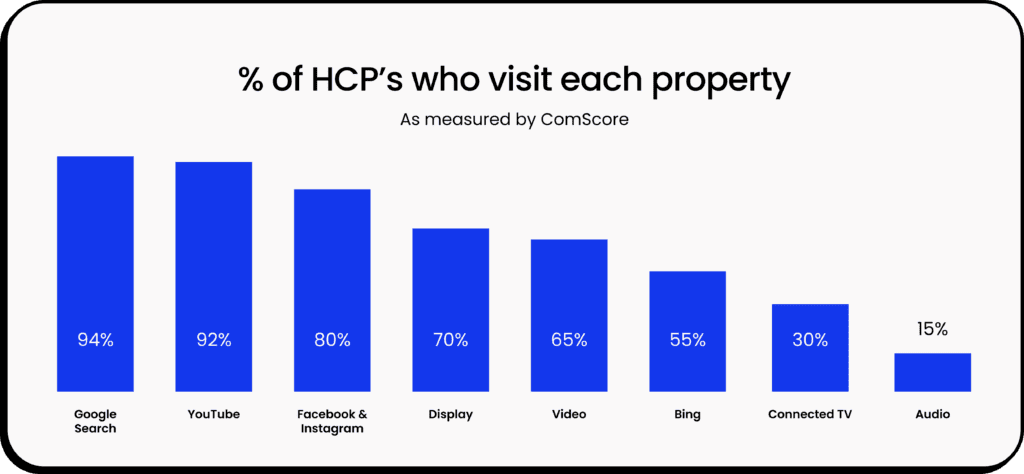
Comscore data supports this behavior:
94% of HCPs use Google Search
92% watch YouTube
80% use Facebook or Instagram
Patterns vary by specialty, but the need for omnichannel presence remains consistent.
Create Impact With Valuable Content
Reaching the right clinicians is only the first step. The content they encounter determines how they engage with your therapy and whether they return for more information. Clinicians prioritize resources that are clear, credible, and practical for real patient interactions.
Across campaigns, HCPs show strong interest in:
trial updates
patient summaries
side-effect and safety information
printed materials
treatment guides
These resources help clinicians stay current and support day-to-day patient conversations. When campaigns lead HCPs to meaningful and evidence-aligned content, brands build trust and encourage repeat visits. High-value content also creates alignment across the care team, since clinicians in different roles reference the same consistent information.
The Takeaway
To build effective HCP campaigns in Canada:
Reach every decision maker: engage the full care team to improve understanding and support confident adoption.
Think omnichannel: meet HCPs where they learn and research, not only within clinical platforms.
Lead with value: Share content that is timely, useful, and clinically meaningful.
Wrango enables these best practices through deterministic, consented data and cross-channel activation that connects you to verified Canadian HCPs throughout their learning journey.
Connect With Our Team Today
Whether you are launching your first Canadian HCP campaign or planning ahead for 2026, Wrango supports every stage of your strategy, from audience development to activation and reporting.
How to Design HCP Campaigns That Drive Script Lift
Driving script lift requires more than reaching healthcare professionals (HCPs). Success depends on a cohesive strategy that integrates targeting, media mix, creative execution, and measurement, each aligned with how clinical decisions are made.
Kseniia Gaskevich
Marketing Manager, WRANGO
May 26, 2025
Sign up and get the latest insights sent directly to your inbox
Key Takeaways
The four components below are essential for campaigns designed to influence prescribing behavior:
The Right Audience: Use prescribing, diagnosis, and procedural data to reach providers actively treating your condition.
Reach: Most impressions occur on mobile, in-app, and across display, video, and native channels.
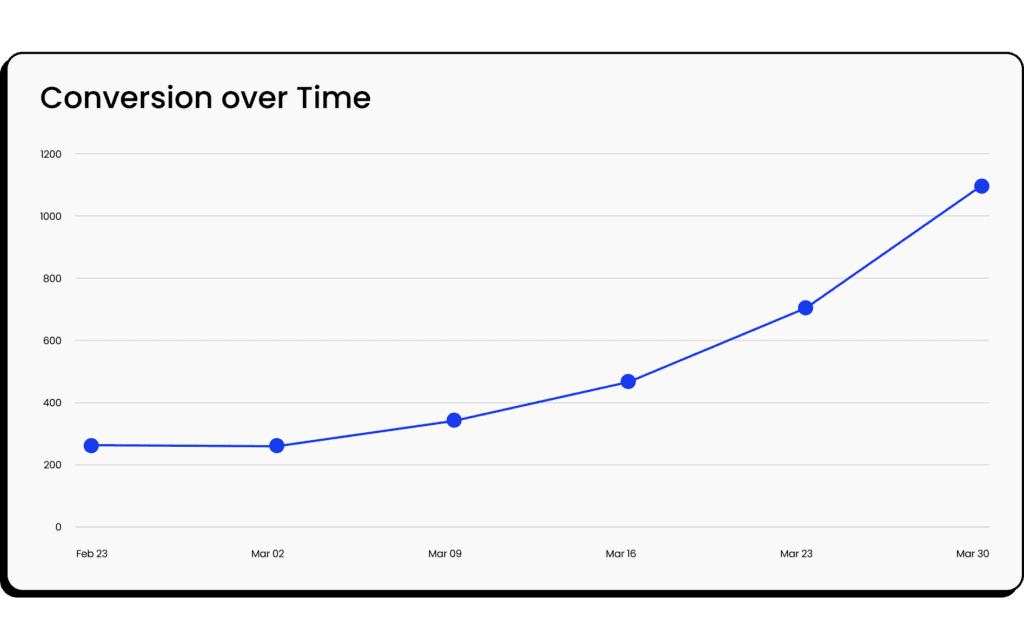
Insights: Go beyond clicks by using pixel data to track return visits and link engagement to NPI-level activity.
Time: Plan for 12 to 16 weeks to build frequency, retarget effectively, and drive measurable script lift.
1. Start with the Right Audience
Many campaigns begin with targeting, but static specialty lists often fall short. They miss the nuance of real-time clinical activity and fail to capture true prescribing intent. To drive meaningful change, targeting must reflect what HCPs are doing, not just who they are.
High-performing campaigns focus on HCPs who are:
Actively treating patients within the relevant therapy area
Writing prescriptions or making diagnoses that align with your brand
Performing procedures connected to your treatment pathway
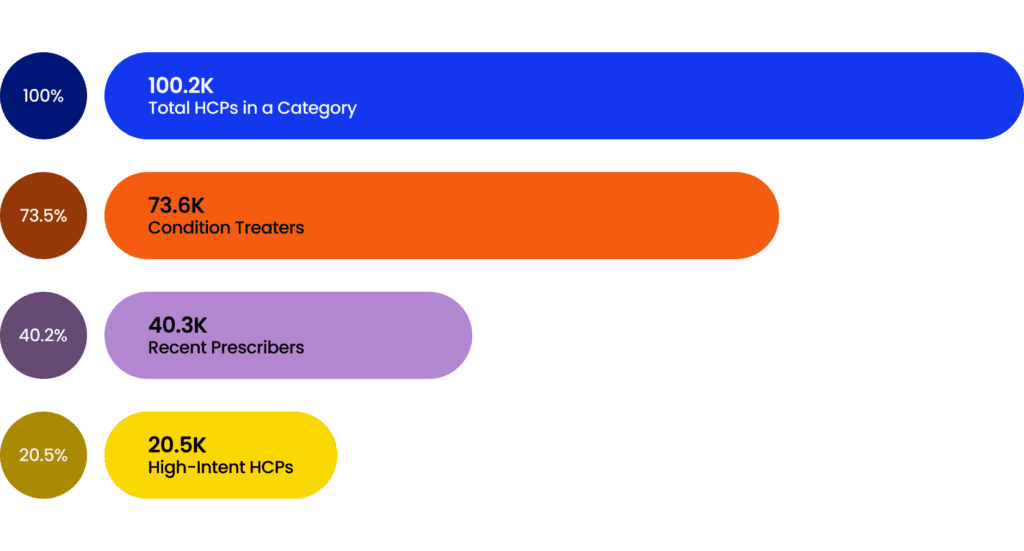
The chart below shows how behavioral filters refine a broad HCP pool into a high-intent audience. From 100,000+ potential HCPs, layers of clinical activity narrow the group to those most likely to engage, based on recent treatments, prescribing history, and procedure data.
This approach ensures your media budget reaches the most relevant HCPs, improving campaign precision and impact.
The most effective strategies use multi-payer claims data to build dynamic, NPI-level segments that are refreshed regularly to reflect evolving clinical patterns.
When audiences are based on real-world activity, campaigns deliver stronger relevance, higher engagement, and more measurable outcomes.
2. Plan Channel Mix to Maximize Reach
Maximizing reach and frequency requires more than just increased spend. Campaigns must be planned around how HCPs actually consume content across devices and platforms.
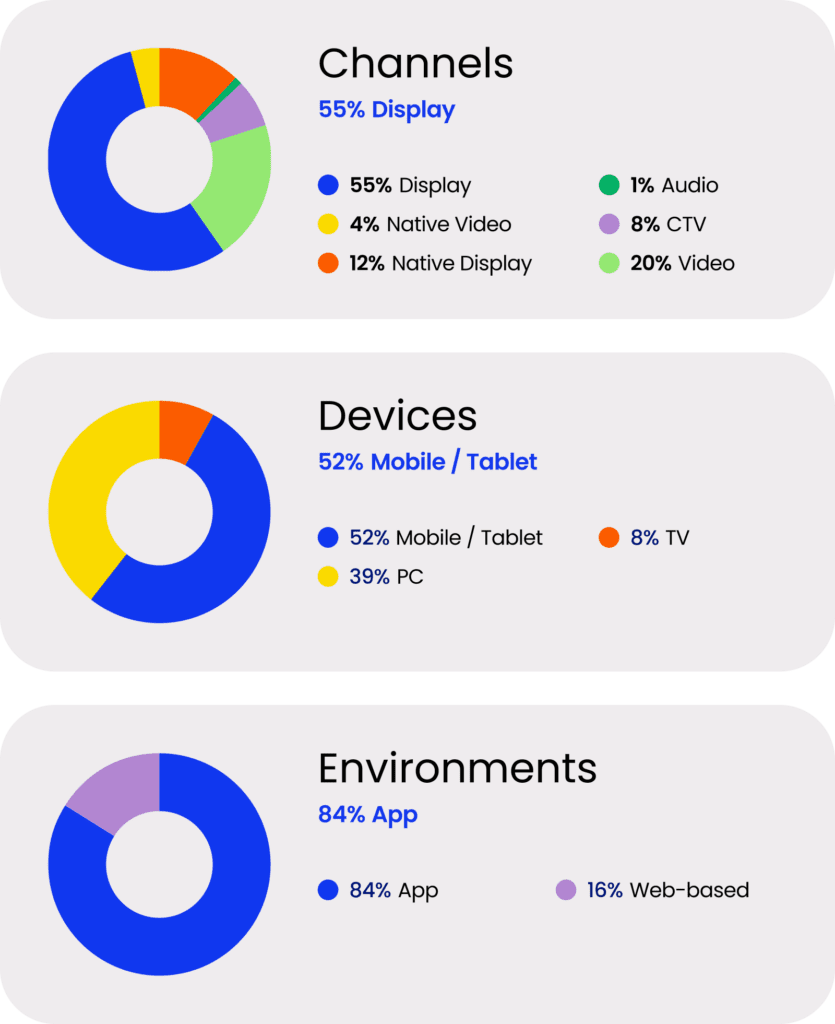
Trade Desk data (Q2 2025) shows that over 50 percent of impressions are served on mobile, and 84 percent appear in-app. Most inventory is split across display (55 percent), video (20 percent), and native (16 percent) formats.
To reach HCPs effectively, campaigns should:
Use at least five formats to diversify delivery and increase touchpoints
Prioritize mobile-first and responsive creative
Include display banners, short-form video, and native formats
Optimize placements for in-app environments
Source: Addressable media mix for 1.3M U.S. physicians via Trade Desk, Q2 2025.
This approach ensures content appears where and how HCPs are most likely to engage, resulting in better delivery, stronger frequency control, and higher overall impact.
3. Track Behavior Beyond the Click
Click metrics only capture surface-level interaction. To influence prescribing decisions, campaigns must measure how HCPs engage after exposure.
That begins with a website pixel.
A well-placed pixel allows marketers to monitor:
Page views, scroll depth, and time spent on key content
Return visits across multiple sessions
View-through conversions that occur without direct interaction
When paired with NPI-level targeting, this behavioral data becomes actionable. Marketers can link activity back to individual HCPs, identify high-intent behaviors, and optimize messaging accordingly.
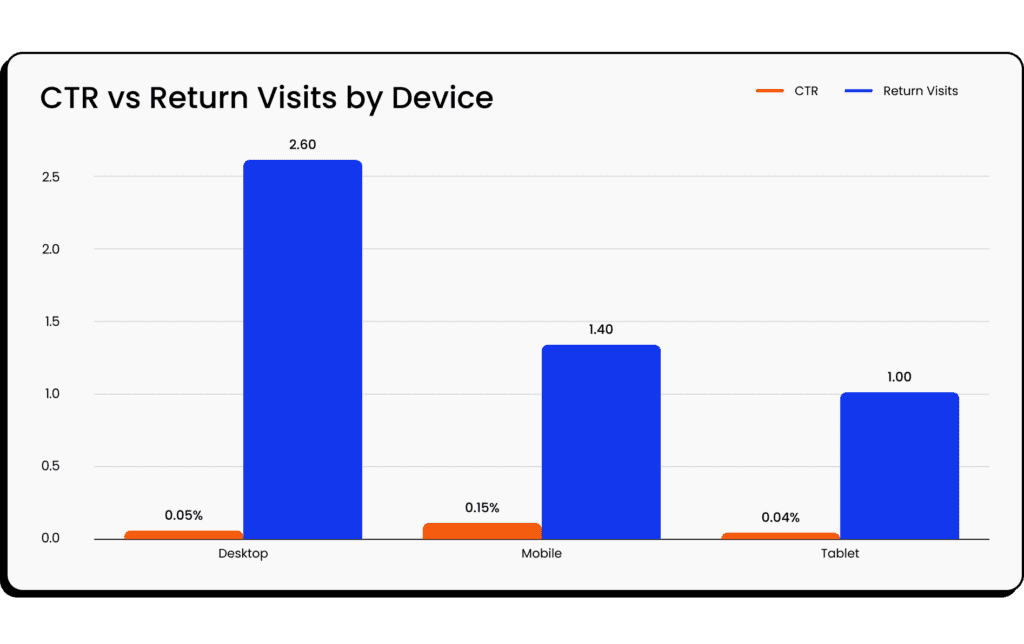
Wrango’s data shows that desktop users are twice as likely to return to site content compared to mobile users. This trend is especially strong among physicians and nurse practitioners, indicating deeper research behavior on desktop.
By focusing on meaningful signals, not just clicks, marketers can make better decisions and strengthen campaign performance throughout the HCP journey.
4. Give it Time to Work
Prescribing behavior evolves gradually. It is shaped through repeated exposure, message reinforcement, and trust over time. Short campaigns often underperform because they do not align with how HCPs make clinical decisions.
To drive measurable script lift, campaigns must be given enough time to build frequency, sequence messaging, and re-engage interested HCPs.
Running a campaign for 12 to 16 weeks allows for:
Sequenced messaging across the decision journey
Strategic retargeting of engaged NPIs
Sustained exposure that builds familiarity and recall
When combined with intent-based targeting and omnichannel media, longer campaigns show compounding effects. Over time, consistent engagement strengthens brand perception and increases the likelihood of influencing prescribing choices.
Giving a campaign time to run its full course ensures alignment with real-world clinical decision-making patterns.
Final Thoughts
When campaigns are grounded in real-world behavior, delivered through relevant channels, measured with purpose, and given time to resonate, influencing prescribing becomes a repeatable outcome.
By applying these principles, marketers can move beyond impressions and begin shaping the decisions that ultimately improve patient care.
Ready to Go?
Connect with our team for tailored HCP insights and a strategic media plan built just for you.
Transparency in HCP Marketing: Why It Matters More Than Ever
Transparency in healthcare marketing is essential for trust, accuracy, and impact. Brands need clear visibility into data, performance, and pricing to drive meaningful HCP engagement.
Joshua Alvernia
CEO, WRANGO
March 7, 2025
Sign up and get the latest insights sent directly to your inbox
Data Transparency
Trust Starts With Accuracy
In healthcare marketing, data accuracy is the foundation of effective engagement. Without clean, verified, and compliant audience data, brands risk delivering misleading insights, which can weaken communications and reduce engagement with HCPs. Ensuring that data is reliable not only improves targeting but also fosters trust between brands and healthcare professionals.
How Wrango Ensures Data Transparency:
Built on Real-World Data (RWD): We leverage medical claims, pharmacy claims, and EHR event data from verified sources to ensure precise audience segmentation.
Patient-Centric Insights: By integrating patient journey data, Wrango doesn’t just identify prescribers—it provides context around how many patients an HCP treats, payer type composition, and estimated adherence rates.
HIPAA-Compliant & SOC 2 Type II Certified: We prioritize non-PII, anonymized insights, ensuring full compliance with industry regulations while maintaining audience accuracy.
HCP-Level Engagement Tracking: Our platform connects HCP interactions across campaign signals, website activity, and survey insights, creating a more complete view of engagement while adhering to strict data privacy protocols.
Transparent data fosters credibility and stronger HCP engagement, enabling brands to deliver accurate, data-backed insights that drive better decision-making.
Measurement Transparency:
Proving Real Impact
Healthcare advertisers invest heavily in campaigns, but without clear measurement, understanding real-world impact can be challenging. Traditional metrics like clicks and impressions only tell part of the story, often lacking visibility into how HCPs engage beyond the ad.
Wrango provides full-funnel measurement, ensuring brands gain deeper insights into HCP engagement across multiple touchpoints.
Beyond Clicks: Track how HCPs move from ad exposure to deeper engagement on branded content.
Cross-Channel Attribution: Identify which media—programmatic, search, social, endemic—drives meaningful engagement.
HCP Journey Analysis: Measure real-world behavior across digital touchpoints to refine targeting and messaging.
Predictive Insights: Use historical data to identify high-intent HCPs and optimize outreach.
With Wrango, brands don’t just measure engagement—they understand what drives action and optimize campaigns with confidence.
Pricing Transparency:
No Hidden Costs, Just Clear Value
Pricing in healthcare marketing is often complex, with varying costs for audience targeting, media buying, and measurement. Without clear visibility, advertisers may struggle to allocate budgets effectively.
At Wrango, we simplify pricing and eliminate uncertainty by offering:
Flat, transparent pricing for HCP audiences—no additional costs for refining segmentation.
No hidden fees for data access, targeting, or measurement—ensuring full budget clarity.
Flexible service models including self-service and managed service, allowing brands to choose the best approach for their needs.
With a straightforward pricing structure, advertisers can make informed decisions, optimize budgets, and maximize the impact of their campaigns with confidence.
Why Transparency is the Key to Smarter HCP Marketing
Transparency isn’t just a best practice—it’s a strategic advantage. When healthcare brands can trust their data, measure real engagement, and invest with confidence, they maximize both impact and efficiency. At Wrango, we’re setting a new standard for transparency in HCP marketing, ensuring brands can deliver reliable insights that empower practitioners to make informed treatment decisions.
Ready to Go?
Connect with our team for tailored HCP insights and a strategic media plan built just for you.
The Future of HCP Engagement: Redefining Healthcare Marketing with Behavioral Insights
HCP engagement is evolving beyond clicks and impressions. Discover how behavioral insights are reshaping healthcare marketing for deeper, data-driven connections.
Joshua Alvernia
CEO, WRANGO
March 7, 2025
Sign up and get the latest insights sent directly to your inbox
The Challenge:
Traditional targeting is no longer enough
HCP engagement is evolving. Traditional targeting helps reach the right physicians, but truly effective marketing requires understanding how HCPs interact with content, what influences their decisions, and when they take action.
Standard performance metrics like clicks and impressions offer a limited view, while behavioral insights provide a clearer picture—revealing the digital touchpoints that shape prescribing behavior.
The Shift
Use engagement data that goes passed the impression or click to measure intent
Wrango’s HCP Journeys Analytics bridges this gap by combining real-world clinical data with digital engagement tracking. Our approach moves beyond traditional audience segmentation to answer critical questions that influence prescribing behavior:
Who is engaging? Understand which HCPs interact with content most—not just by specialty, but by behavioral intent.
Where are they engaging? Identify the channels, content, and messaging that resonate best.
What drives action? Gain visibility into how engagement translates into real-world outcomes, such as increased prescribing intent.
HCP engagement spans multiple touchpoints. Wrango’s HCP Journeys Analytics enables marketers to track, interpret, and act on these signals in real time.
The Data
What We’ve Learned from HCP Journeys Analytics
HCP engagement is an ongoing process, not a single interaction. Wrango’s analysis of HCP behavior reveals key insights that help brands refine targeting and drive meaningful engagement:
Engagement goes beyond the ad. HCPs often move from ads to educational content and brand websites, signaling deeper interest.
Not all engagement is equal. Clicks and video completions don’t always indicate intent—tracking post-click behavior helps distinguish passive viewers from active researchers.
Website behavior signals prescribing intent. HCPs exploring condition-specific resources and treatment pages are more likely to be in the decision-making process.
These insights reveal that engagement goes beyond clicks—it signals intent. Wrango’s HCP Journeys Analytics helps brands track, interpret, and act on these signals in real time for more strategic outreach.
The Opportunity
Leveraging behavioural data makes your campaign smarter and more likely to succeed
With HCP Journeys Analytics, brands can go beyond traditional segmentation and leverage real-world behavioral insights to enhance their marketing strategies:
Build high-intent HCP audiences. Move beyond specialty-based targeting by segmenting HCPs based on diagnoses, procedures, prescriptions, and tests for a more precise approach.
Optimize messaging in real time. Track HCP engagement across campaigns and websites to refine content dynamically and ensure relevance.
Measure the full HCP journey. Connect campaign signals, website interactions, and survey insights to gain a comprehensive view of engagement from discovery to prescription.
By harnessing behavioral data, brands can create more personalized, data-driven campaigns that resonate with HCPs and drive meaningful impact.
The Future of HCP Engagement Is Here
Traditional targeting and surface-level metrics no longer capture the complexity of HCP decision-making. Wrango’s HCP Journeys Analytics connects digital engagement with real prescribing intent, enabling brands to move beyond visibility to meaningful impact. By tracking how, when, and why HCPs engage, marketers can optimize every touchpoint, refine strategies in real time, and drive smarter, data-backed decisions.
Ready to Go?
Connect with our team for tailored HCP insights and a strategic media plan built just for you.